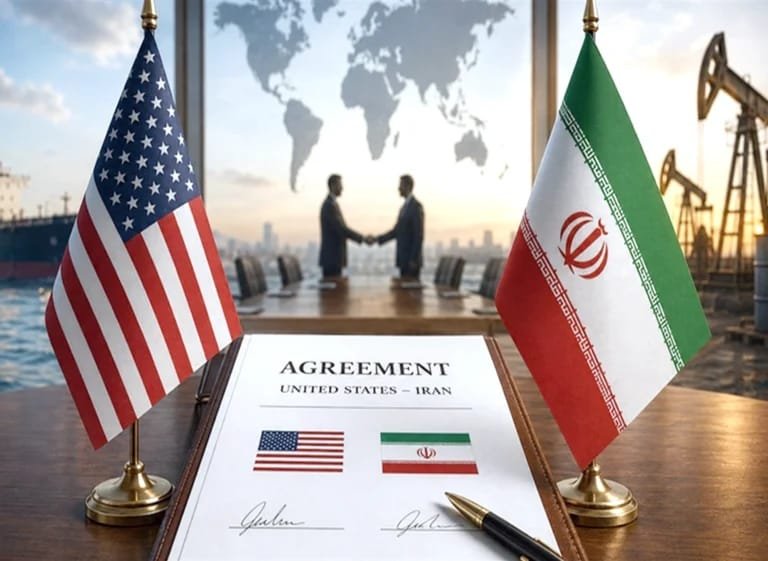
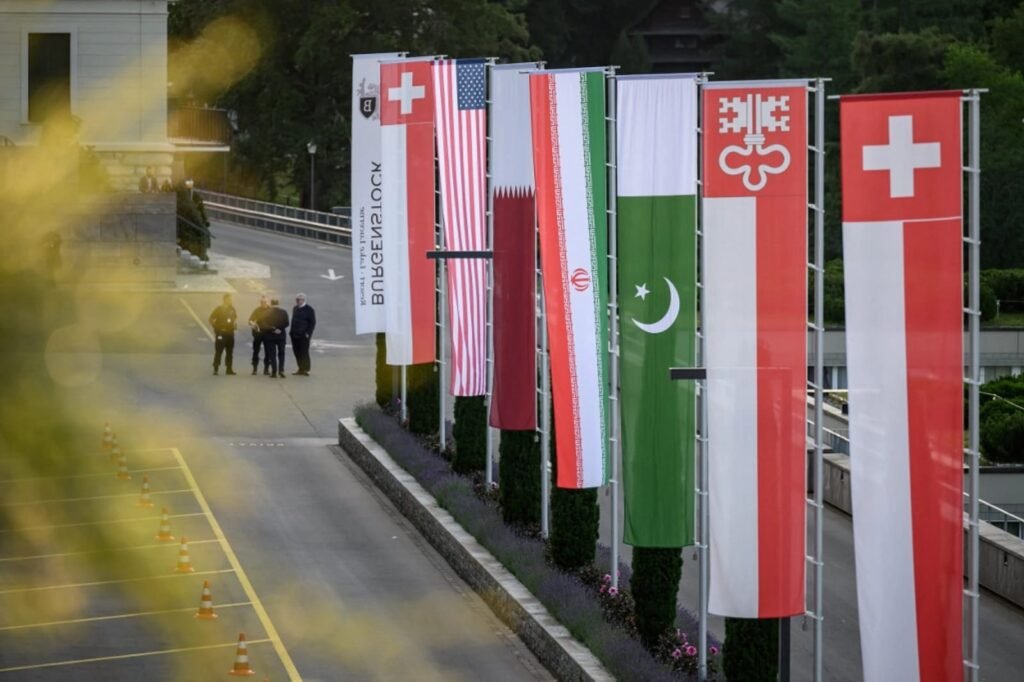
In Switzerland, the United States and Iran wrapped up a new round of discussions on Monday, with Qatar and Pakistan, acting as intermediaries, reporting “positive momentum” and outlining a 60-day framework aimed at reaching a final understanding. US Vice President JD Vance described the talks as laying a “solid basis” for further progress, noting that Iran had agreed in principle to permit the return of International Atomic Energy Agency (IAEA) inspectors. In parallel, Washington approved a temporary 60-day waiver allowing Iran to continue exporting oil and petrochemical products until August 21. It is being projected as diplomatic progress, but its underlying structure reflects redistribution of leverage that strengthens Tehran’s strategic depth while leaving Israel with narrowed deterrence space and rising uncertainty across multiple fronts.
At the center of the concern is a familiar pattern in Iran-related diplomacy over the past two decades. Agreements framed around “verification,” “de-escalation,” or “temporary licensing” have repeatedly translated into material breathing room for Iran’s regional network. The current arrangement follows that trajectory. Even limited sanctions relief, such as temporary permissions tied to oil and petrochemical flows, creates immediate fiscal space for a state that has consistently allocated a significant portion of its external revenue streams to asymmetric warfare infrastructure, including ballistic missile development and proxy financing. Independent assessments, including those referenced in regional security analyses over the years, have consistently estimated Iran’s annual support to non-state armed partners in the hundreds of millions of dollars, with Hezbollah alone historically receiving support often assessed in the range of roughly $700 million per year at peak levels prior to intensified sanctions cycles.this is not an abstract economic adjustment. It is a force multiplier. Every easing mechanism in Iran’s fiscal pressure system translates into operational resilience for its regional network. Hezbollah’s estimated arsenal, frequently assessed at over 120,000 to 150,000 rockets and missiles, remains the most immediate deterrence challenge on Israel’s northern front. Any financial stabilization for Tehran is interpreted through that lens: replenishment capacity, procurement continuity, and sustained readiness across multiple theaters including Lebanon, Syria, Iraq, and Yemen.
The inclusion of a Lebanon “deconfliction mechanism” within the Switzerland discussions has intensified these concerns. While presented as a stabilizing technical arrangement, its implications are strategically sensitive. For Israel, Hezbollah is not a theoretical actor in a diplomatic model; it is a militarized force embedded along a live border, with documented precision-guided missile expansion and drone capabilities that have evolved significantly since 2020. Introducing external procedural layers between Israeli operational responses and Hezbollah activity is therefore viewed as a structural constraint on deterrence freedom rather than a confidence-building measure.
In addition to the above, there is also the issue of sequencing within the diplomatic pathway. It seems as though Iran has managed to achieve the phased engagement without putting any irreversible structural restraints in place from the very start. There is also historical precedent that must be considered when discussing the matter. In previous nuclear negotiations, for instance the Joint Comprehensive Plan of Action (JCPOA) of 2015, there were verification procedures and phased relief structures in place, thus allowing Iran to keep its enrichment capabilities intact during the sanctions relief process. Over the years there has been a lot of IAEA reporting on the return of compliance loopholes, threshold violations and centrifuge development cycles.The announcement of an inspection element in Switzerland also introduces structural ambiguity. In the past, Iran’s adherence to the international inspections has been variable, depending on its internal politics and escalation patterns in the region. Even if there is permission to conduct inspections, delays in the process, restrictions on sites of inspection, or interpretation of the scope of inspection has made it difficult for verification mechanisms to be effective. For Israel, there is an old pattern of asymmetry where diplomacy moves in phases measured in months, while nuclear latency and missile production cycles are measured in technical acceleration curves that do not pause for negotiations.
Strategically, the most consequential dimension is not only what Iran gains directly, but what it gains indirectly through perception. Regional proxies interpret diplomatic relief as validation of endurance under pressure. Hezbollah, already operating with entrenched military infrastructure in southern Lebanon, reads financial stabilization as continuity insurance. Hamas-linked structures and Palestinian Islamic Jihad networks similarly interpret external concessions as confirmation that strategic pressure on Iran does not translate into isolation, but into negotiated survivability.
The core criticism emerging from Israeli security analysis is therefore not about diplomacy in principle, but about asymmetry in outcomes. Iran secures phased relief, political legitimacy in negotiation architecture, and preserved regional leverage. The enforcement side remains conditional, delayed, or dependent on future political alignment. That imbalance is what defines the current Switzerland framework in Israeli threat perception.
The deal’s most damaging flaw lies in its real-world effect: it trades immediate pressure on Iran for delayed accountability, while leaving its regional proxy network intact and operational. In strategic terms, that is not de-escalation, it is force multiplication with a time lag. Tehran emerges with expanded breathing space, renewed economic channels, and restored diplomatic cover, while the burden of uncertainty shifts onto Israel, which is left to absorb the security risk of a strengthened adversary operating under the shield of negotiations. And after all the concessions are counted, one question lands with blunt force: what is on the negotiation table for Israel?