
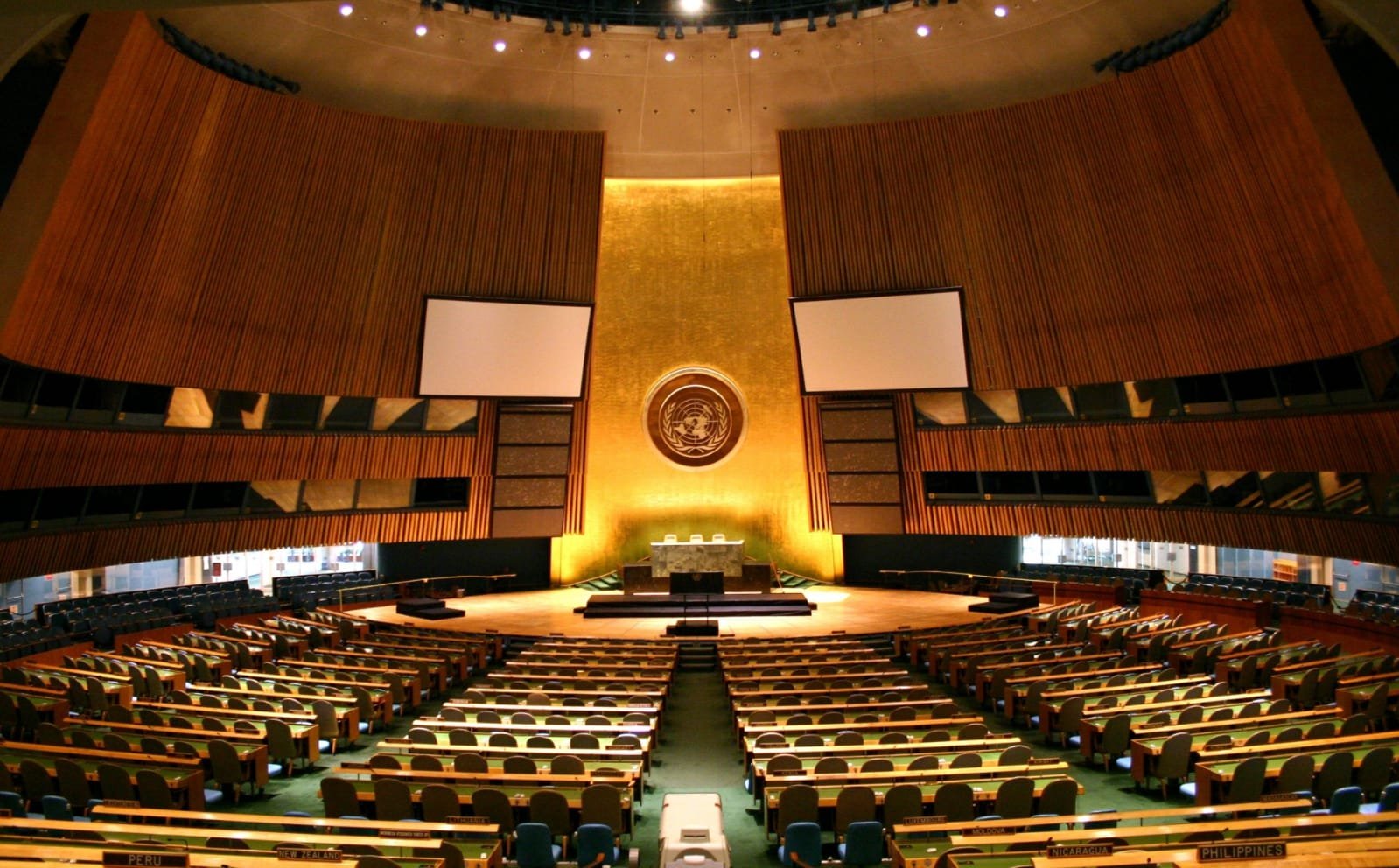
The annual pilgrimage of an Israeli prime minister to the United Nations General Assembly in Turtle Bay has long been a centerpiece of Jerusalem’s national security architecture. For decades, it offered a grand stage to state the country’s strategic case directly to world leaders, challenge hostile diplomatic blocks, and project international authority. Yet, as Benjamin Netanyahu took the green marble podium for his 15th address, the dynamic underwent a profound mutation. The global forum was transformed into localized campaign theater, intended primarily for an electorate back home that will head to the voting booths in just over a month.
The optics of the visit were designed to reinforce a familiar thesis: Israel is besieged by a hostile world, and only one leader possesses the stature and iron will to stand up to that hostility. In previous campaign cycles, Netanyahu relied on the currency of international prestige. He plastered Tel Aviv billboards with images of himself shaking hands with world figures like Donald Trump, Vladimir Putin, and Narendra Modi. That message framed him as a statesman in a different league, capable of opening any door in world capitals.
Today, the political calculus has fundamentally inverted. Confronted with mounting international isolation, an International Criminal Court arrest warrant that severely limits his Western travel, and mass delegation walkouts inside the UN hall, Netanyahu is no longer campaigning on the warmth of his alliances. He is campaigning on the hostility of his detractors. In this strategic reframe, the defiance shown to figures like French President Emmanuel Macron, Turkish President Recep Tayyip Erdogan, or local critics like New York City Mayor Zohran Mamdani becomes the product itself. The hostility of international institutions is systematically converted into a primary political qualification.
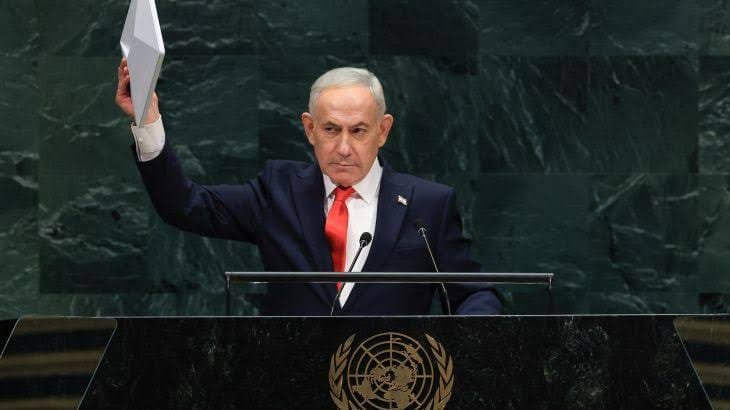
The timing of this transatlantic trip underscores the urgency behind the strategy. Flying to New York just 33 days before Election Day without a guaranteed meeting with President Trump was a calculated political risk. Trump spent his Thursday in Washington hosting Chinese President Xi Jinping, while Netanyahu had to leave New York before Shabbat and the onset of Sukkot. In normal political times, failing to secure a joint photograph with an American president on the eve of a vote would be branded a diplomatic snub. But in an election where Trump’s personal standing among Israelis has shifted—with recent Israel Democracy Institute polling showing the percentage of Israelis who believe Trump prioritizes Israel’s security dropping sharply from 60 percent to 28 percent—the absence of that photo op was secondary. For Likud strategists, the image of Netanyahu standing alone at the UN rostrum offered a far more potent visual asset.
Props have always served as the signature hallmark of Netanyahu’s diplomacy. From the Auschwitz-Birkenau blueprints in 2009 to the cartoon redline bomb in 2012, 44 seconds of deafening silence in 2015, and the green-marker map of the Middle East in 2023, visual theater has been his primary tool to bypass diplomats and capture headlines. This time, he brandished a Starlink satellite device, framing it as a beacon of information freedom that Tehran’s regime deeply fears. Yet, the ultimate prop of the entire trip was the UN chamber itself. The backdrop was deployed adroitly to portray a wartime leader entering the lion’s den to speak hard truths to a dismissive international community.
The central question remains whether this political performance can alter a stubborn domestic reality. Within hours of his speech, Likud advisers circulated videos contrasting the prime minister’s fluent English with the more straightforward, unvarnished delivery of his chief rival, former IDF Chief of Staff Gadi Eisenkot. The political intent was clear: convince wavering right-wing voters that Eisenkot lacks the global communication skills necessary to defend Israel on the world stage.
However, Israeli public opinion today is deeply shaped by local security realities. Polling data from recent weeks demonstrates how volatile the electorate remains. Channel 13 surveys have shown razor-thin margins between the ruling coalition and opposition forces, with the opposition led by Eisenkot’s Yashar party routinely challenging Likud’s dominance. For millions of Israelis, the vote on October 27 will not be decided by how effectively a speech plays in foreign news clips. It will be decided by the unresolved trauma of October 7, the ongoing multi-front warfare spanning Gaza, Lebanon, and Iran, the bitter debates over military conscription for the ultra-Orthodox community, and the heavy economic toll borne by call-ups of military reserves.
The strategic gamble at the heart of Netanyahu’s campaign is that international condemnation can be indefinitely weaponized to consolidate power at home. It operates on the assumption that domestic voters will view foreign criticism not as a failure of statecraft, but as proof that the prime minister is fighting the right battles. Yet, there is a growing disconnect between public diplomacy theater and national security outcomes. When foreign delegations walk out, when international courts issue warrants, and when long-standing diplomatic bridges erode, the long-term cost to Israel’s standing cannot be brushed aside as a simple public relations problem.
For decades, the public bought into the premise that global communication skills were synonymous with national security. Today, after three years of profound regional turmoil, Israeli voters are far more skeptical of rhetorical polish. They understand that a virtuoso performance in New York does not automatically translate into strategic clarity on the northern border, stability in the South, or domestic social cohesion.
As the political machinery prepares for the final stretch of the campaign, the limits of global theater are being tested. Netanyahu used the UN General Assembly to demonstrate that he remains an unmatched master of political spectacle. Whether that spectacle can shield his coalition from an electorate demanding accountability, institutional renewal, and a coherent exit strategy from endless conflict is another matter entirely. In the end, performance art at Turtle Bay may capture international headlines, but it is the voters in Petah Tikva, Ashdod, and Tel Aviv who will decide whether the show has finally run its course.