
Technical Assessment of Subterranean Military Operations and Strategic Disruption
1. The Fortress of Pickaxe Mountain
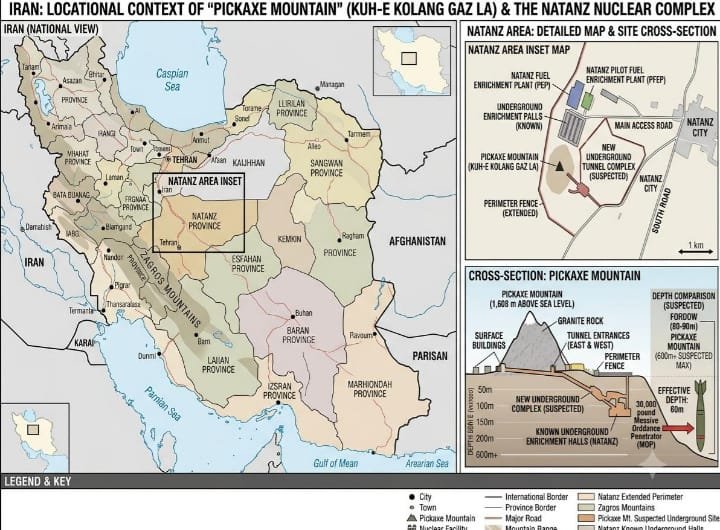
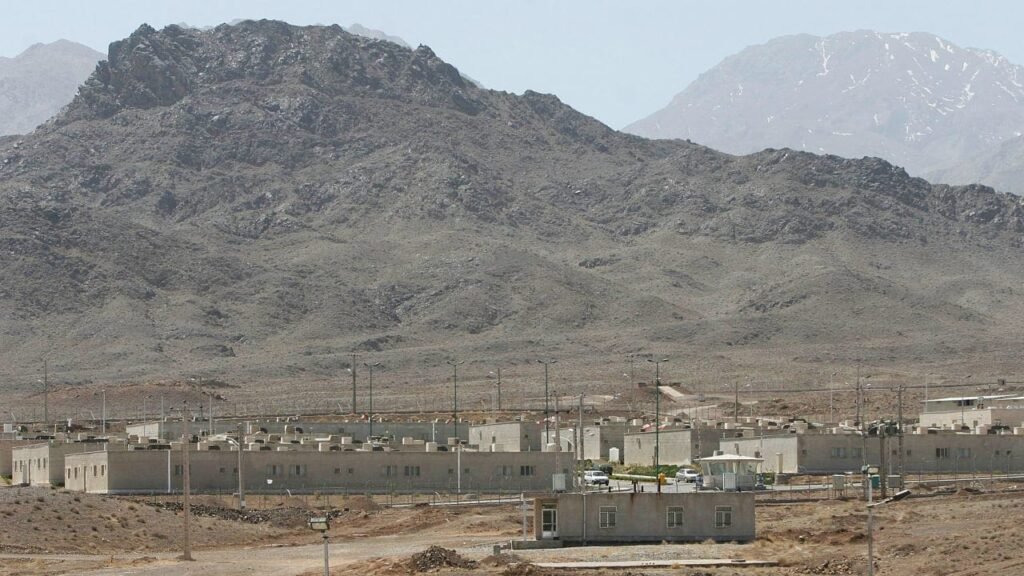
The military rhetoric surrounding Iran’s subterranean nuclear infrastructure has reached a fever pitch, with Washington explicitly signaling that Pickaxe Mountain, known in Farsi as Kuh e Kolang, is squarely in its targeting sights. The site, buried deep beneath a massive granite mountain south of the main Natanz enrichment complex, represents Tehran’s ultimate insurance policy against foreign air strikes. Intelligence estimates indicate that the facility sits between 100 and 140 meters beneath solid rock, heavily reinforced with engineered concrete shields and dual layered defensive perimeters. For American and Israeli defense planners, Pickaxe Mountain poses an acute operational dilemma. The fundamental question is no longer whether Washington possesses the political willingness to strike, but whether conventional military technology can physically destroy a target engineered to withstand the heaviest ordnance in the Western arsenal.
2. Limits of Conventional Kinetic Engineering
A cold technical assessment yields a sobering conclusion: completely collapsing or destroying the main underground halls of Pickaxe Mountain via conventional air power remains beyond guaranteed military capabilities.Evaluating deep penetration capabilities. The primary weapon designed for hardened subterranean targets is the American GBU 57 Massive Ordnance Penetrator (MOP), a 30,000 pound precision guided bunker buster. The MOP is a masterpiece of kinetic engineering, capable of penetrating roughly 60 meters of earth and reinforced concrete before its delay fuze detonates the warhead. Air Force doctrine envisions launching multiple GBU 57s in rapid succession onto a single target point, a tactic where the first bomb craters the upper rock layer and the second penetrates deeper into the void created by the first.However, geology favors Tehran. Granite is among the hardest natural stone formations on Earth, exhibiting immense compressive strength that rapidly dissipates kinetic energy. Even a sequential two bomb strike by B 2 stealth bombers cannot reliably penetrate 100 to 140 meters of solid granite topped with reinforced overhead concrete slabs. The physics of kinetic impact dictate that beyond a certain depth, the rock mass absorbs the shockwave, protecting the hollow caverns below from structural collapse.
3. Redefining Targeting Strategies: Functional Neutralization
This technical reality forces planners to redefine what destruction means in modern air warfare. If collapsing the subterranean centrifuge halls is unachievable from the air, military strategists must pivot toward functional neutralization.An underground facility does not need to be physically flattened to be rendered totally useless. Deep mountain bunkers rely on vulnerable surface connections to function. They require massive intake and exhaust shafts for ventilation, cooling systems to regulate temperature for delicate centrifuges, heavy duty electrical conduits, communication lines, and reinforced tunnel portals for transport.
4. Operational Disruption of Vital Infrastructure
A sustained, precision air campaign targeting key nodes would effectively seal the facility. Penetrating munitions aimed at tunnel entrances can cause massive rockslides, entombing the portals under thousands of tons of debris. Striking ventilation shafts with high explosive ordnance creates overpressure waves that travel through the air ducts, destroying sensitive environmental controls and potentially damaging centrifuges inside. Striking external power grids and backup generators starves the underground complex of electricity. Under such conditions, Pickaxe Mountain becomes an operational tomb. The centrifuges and enriched uranium stockpiles inside may remain physically intact, but the facility is rendered completely inert, unable to operate, receive supplies, or export nuclear material.
5. High Risk Escalation Scenarios
To achieve permanent, physical destruction of the site, military options degrade into high risk, catastrophic scenarios. The first is a large scale ground assault utilizing special operations forces or airborne units. The objective of such an operation would be to secure the tunnel entrances, breach the heavy blast doors, clear the underground complex room by room, and place specialized demolition charges directly against the main structural supports to trigger a total internal collapse.Military planners in Washington and Jerusalem understand that a ground assault on Pickaxe Mountain would be an operational nightmare. The facility is situated inside a heavily fortified military zone surrounded by anti aircraft artillery, surface to air missile batteries, and rapid reaction units of the Islamic Revolutionary Guard Corps. Invading forces would face narrow subterranean choke points, booby trapped blast doors, and defensive positions tailored for close quarters ambush. The historical shadow of Operation Eagle Claw, the failed 1980 rescue mission in the Iranian desert, serves as a constant reminder of the extreme risks involved in heliborne operations deep inside hostile Iranian territory. The human cost of a ground raid would likely be measured in heavy American casualties, with a high probability of tactical failure if inner blast doors cannot be breached quickly.
6. Tactical Nuclear Considerations and Physical Realities
The second theoretical alternative is the deployment of low yield tactical nuclear weapons, such as the B61 11 earth penetrating nuclear bomb. Designed specifically to couple nuclear explosive energy directly into the ground, a tactical nuclear strike generates massive seismic shockwaves capable of crushing deeply buried structures. However, even leaving aside the catastrophic political, diplomatic, and environmental consequences of breaking the nuclear threshold, the geological depth of Pickaxe Mountain means that even a low yield nuclear detonation might fail to crush the deepest caverns, while simultaneously dispersing radioactive fallout across the region.
7. Strategic Imperatives for Regional Security
For Israel, the implications of this military assessment are profound. Jerusalem cannot afford to rely on speculative assumptions about Washington’s ability or willingness to flatten Pickaxe Mountain from the skies. If air strikes can only achieve temporary neutralization rather than permanent destruction, Iran will eventually clear the blocked tunnels, repair its ventilation shafts, and resume enrichment activities once the diplomatic or military pressure recedes.The strategic imperative for Israel and its American ally is to recognize the limits of kinetic power. Air strikes on Pickaxe Mountain can buy critical time by severing infrastructure and burying tunnel entrances, but they cannot erase the technology, knowledge, or physical caverns Tehran has constructed. Preventing a nuclear armed Iran requires a continuous combination of kinetic disruption, offensive cyber operations, intelligence sabotage, and relentless diplomatic isolation. Pickaxe Mountain may well be immune to absolute physical destruction from high altitude bombers, but a facility cut off from power, sealed beneath thousands of tons of blasted rock, and isolated from the outside world is a fortress that has lost its strategic purpose.