

Modern Israel’s doctrine of security relies increasingly on what it can intercept, destroy, or deter from the sky. Missile launches are monitored in real time, unmanned aircrafts are intercepted in flight, and highly accurate attacks strike targets before they can fully develop their threatening potential.
This military advantage is very real, demonstrable, and unique in many ways. The increasing reliance on missile and aerial defense, however, reveals a broader asymmetry regarding the understanding of security itself.Security is gradually being equated with interception success rates, strike accuracy, and operational tempo.
These are critical metrics, but they do not answer a more fundamental question: what kind of regional order is being built alongside them, if any at all? A system can become extraordinarily effective at stopping incoming threats while still remaining strategically exposed to the conditions that generate those threats in the first place.
Herein lies the paradox in Israel’s current security environment. The better its missile-based defense system is, the greater the chances are that it will address symptoms and not the root cause. The failure is not in terms of capability but of scale.The region surrounding Israel has evolved into a layered threat ecosystem. State actors, non-state militias, and hybrid networks operate across borders with varying degrees of coordination, often testing Israel’s defenses through distributed and low-cost systems. Drones and short-range rockets have become particularly significant because they are cheap to deploy, difficult to fully eliminate, and politically easy to regenerate.In this regard, missile defense, however high-tech it may be, is only a form of containment and not resolution, since it reduces the threat, but does not lessen the motivation behind it. It shoots down missiles, but it cannot end the political environment that leads to their launches.
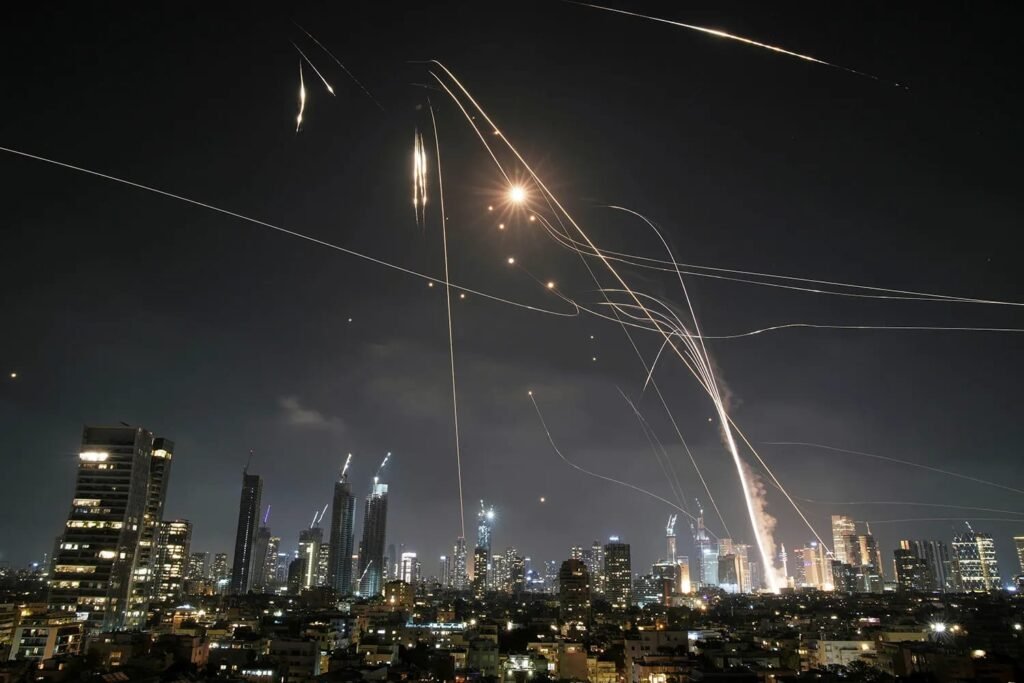
The danger is not that these systems fail, but that their success creates a sense of strategic sufficiency. When incoming threats are consistently neutralized, it becomes easier to assume that the underlying environment is being controlled as well. In reality, the environment may simply be adapting faster than it is being transformed.
This trend also brings about the problem of operational saturation. Given that there are threats arising from various fronts such as Lebanon, Gaza, Syria, Yemen, and other places at once, Israel is expected to remain under constant high alert from various directions. Missile defense systems are stretched not by breakdown, but by constant activation. The system works, but it never rests.This leads to a gradual evolution of the concept of deterrence. Deterrence in the classical sense implies that the adversary will adjust his approach following the imposition of a cost on him.
However, due to the fragmentary and ideologically charged nature of the regional dynamics, deterrence tends to be cyclical, as actors learn from their failures and come back into the arena through different approaches. The result is not deterrence failure, but deterrence repetition.On the political level, there lies a danger that such a scenario will lead to limited strategic imagination. If the notion of security remains primarily defined by success in the use of force, then other mechanisms such as diplomacy, regional integration, economic power, and a framework for stability may seem like less important options or even non-essential.Israel’s military strength is not in question.
The challenge lies in whether military strength alone can define the boundaries of national security policy indefinitely. A system optimized for interception may still be operating without a corresponding strategy for de-escalation architecture. In such a case, excellence at one level coexists with incompleteness at another.On the internal front, there is also a political-psychological adaptation process. Societies which find themselves living under the constant threat of missile attack on multiple fronts tend to develop very high levels of tolerance to disruption and low expectations for the resolution of conflicts. Intercepting missiles becomes a regular part of everyday existence.
This is where the strategic question becomes unavoidable: can a state define success purely through defensive performance metrics without addressing the long-term persistence of those threats? Or does such a definition eventually lock it into a permanent defensive posture, where security is maintained but never fully stabilized?The answer does not lie in reducing investment in missile defense systems. On the contrary, these systems remain essential. The issue is balance.
A security doctrine heavily weighted toward interception must be matched by parallel efforts aimed at shaping the environment that produces incoming fire in the first place.
It calls for a more expansive strategic perspective than can be achieved by tactical considerations alone. It calls for looking at regional architecture rather than simply threat cycles; political success rather than operational triumphs.
Israeli security has always been based on more than one facet. However, the current trend may end up placing an overwhelming emphasis on one facet. The effectiveness of this framework is beyond doubt. However, its sufficiency is questionable.
A secure future cannot be built solely on the ability to stop what is coming in. It must also address why it keeps coming at all.