An analysis of the sweeping trilateral defense pact between Saudi Arabia, Turkey, and Pakistan, and its profound implications for Israel’s long-term security doctrine.
A Geopolitical Earthquake in Mecca
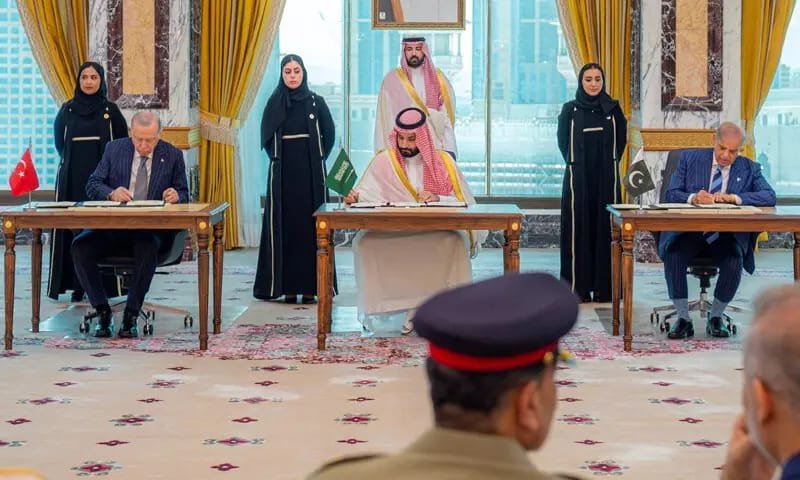
The ink was barely dry in Mecca when Turkish President Erdogan, Saudi Crown Prince Mohammed bin Salman, and Pakistani Prime Minister Shehbaz Sharif locked hands over what amounts to a geopolitical earthquake. Meeting under the weight of mounting regional friction and the chaotic fallout of the ongoing American conflict with Iran, the three leaders signed a sweeping trilateral defense pact. The core clause is genuinely breathtaking in scope. An armed attack on any one signatory now counts as an attack on all three. For Jerusalem, this new Sunni aligned axis combining Saudi money, Turkish military strength, and Pakistani nuclear weapons isn’t just another regional realignment. It’s a genuine strategic nightmare.
The Three Pillars of the Alliance
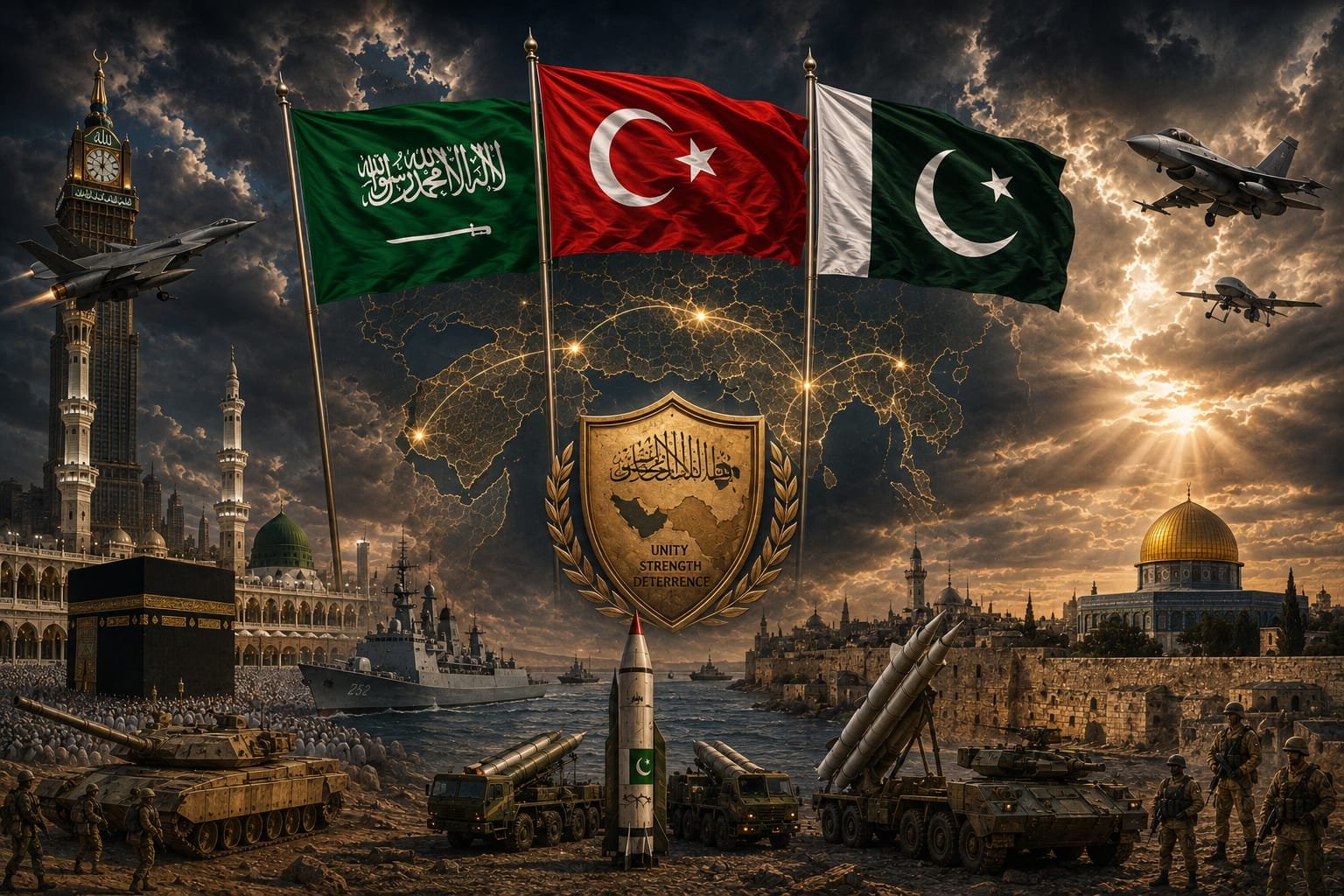
Think about what this pact actually brings to the table. It unites three formidable regional pillars into a single military structure. Saudi Arabia brings essentially boundless financial power and massive capital investment. Turkey contributes a powerful NATO trained military, cutting edge defense manufacturing, and aggressive geopolitical ambition. Pakistan brings a million man standing army, deep conventional combat experience, and most alarmingly, its status as the only nuclear armed state in the Islamic world. When Islamabad extends its security umbrella into the heart of the Middle East, the strategic math changes overnight for every country from the Jordan River to the Persian Gulf.
The Pakistani Nuclear Threat and Ideological Stance
For Israel, the implications are genuinely chilling. Pakistan has long maintained fierce, state sanctioned hostility toward Israel, driven by ideological conviction and religious extremism. The current military and political leadership in Islamabad, led by Army Chief General Asim Munir, operates under a deeply entrenched Islamist worldview that sees Israel through a hostile, zero sum civilizational lens. Munir and his political superiors have consistently refused any form of normalization with Israel, framing the Palestinian cause as a sacred religious duty rather than a policy question. Tying Pakistan’s formidable military apparatus and nuclear deterrent to Riyadh and Ankara means a nuclear armed power with a radicalized ideological posture is now formally woven into Israel’s immediate neighborhood security picture.
Turkey’s Role and Geopolitical Ambition
Turkey’s presence in this triangle adds another layer of real danger. As a NATO member, Ankara already commands enormous diplomatic leverage and military capability, yet under Erdogan, Turkey has become one of the most vocal state critics of Israel anywhere in the world. Erdogan has openly championed Hamas, compared Israeli leaders to war criminals, severed economic ties, and actively worked to rally international coalitions against Israel. By locking in this formal defense pact with Riyadh and Islamabad, Turkey is successfully extending its strategic reach southward, institutionalizing its anti Israel hostility into a binding military treaty backed by Gulf money and the ultimate deterrent of Pakistani warheads.
Vacuuming Protection: The Shifting Middle Eastern Balance
The timing here is no coincidence. With Washington struggling against dwindling interceptor stockpiles and faltering leverage over Iran, regional powers are rushing to fill the security vacuum left behind. The ongoing war between the US and Iran has exposed the real limits of Western protection, pushing Middle Eastern capitals to build independent deterrence networks of their own. But for Israel, a bloc built on Saudi cash, Turkish defense technology, and Pakistani military strength doesn’t function as some stabilizing shield. It creates an intimidating new power center that’s openly hostile to Jewish sovereignty and deeply committed to shifting the regional balance of power away from Israel entirely.
Shattered Assumptions of the Abraham Accords
Israeli security planners need to wake up to this reality. For years, diplomatic optimism centered on expanding the Abraham Accords and pulling Saudi Arabia into a moderate regional security architecture that could help counter Iran. This new trilateral pact shatters that whole assumption. It shows Riyadh is hedging its bets, aligning itself with a hardline Turkish Pakistani bloc that explicitly weaponizes Islamic solidarity against Western and Israeli interests. When a nuclear armed state with an Islamist ideological core enters a mutual defense pact alongside Israel’s most vocal regional critics, the margin for error basically disappears. Jerusalem is now facing an evolving threat landscape that demands total military preparedness, unyielding vigilance, and a complete rethink of its long term strategic alliances.
Structural Division of Labor and Defense CapabilitiesThe structural logic behind this new alliance deserves a closer look too. Riyadh brings deep pockets, funding massive defense research and securing global supply chains. Ankara provides the advanced industrial capacity, producing world class drones, armored vehicles, and naval systems that have already proven lethal on modern battlefields elsewhere. Pakistan contributes sheer manpower, strategic depth, and the ultimate equalizer in its nuclear arsenal. This division of labor creates a self sustaining military industrial complex spanning all three countries, cutting their reliance on traditional Western suppliers and giving them real independent leverage on the world stage.
“Jerusalem isn’t just managing localized threats from asymmetric proxies on its immediate borders anymore. It’s staring down a formidable, nuclear-backed axis.”
Islamabad’s Strategic Projection Under General Munir
General Asim Munir’s role in all this can’t really be overstated. Known for his orthodox religious views and unyielding stance on national security, Munir has steadily steered Pakistan toward a more assertive pan Islamic posture. Under his command, the Pakistani military isn’t just offering conventional deterrence anymore. It’s exporting its strategic doctrine into volatile theaters far from home. By tying the security of the Arabian Peninsula to Pakistan’s own defense, Islamabad is effectively projecting its influence westward, fulfilling a long held ambition of becoming the premier military guardian of the Sunni Muslim world. For a country dealing with severe domestic economic turmoil, projecting outward military strength also serves a powerful internal political purpose, unifying the population around external religious and security alliances.
The Dilemma of Ankara’s Dual Identity
Turkey’s dual identity, a NATO member aggressively pursuing an independent Islamist foreign policy at the same time, poses a genuinely unique dilemma for Western strategists. Erdogan has mastered playing every side at once, extracting technological and diplomatic benefits from the West while actively undercutting Western security architecture across the Middle East. By tying Turkish military strength to Saudi capital and Pakistani strategic depth, Ankara is anchoring itself at the center of a powerful new bloc capable of projecting power across the Mediterranean, the Gulf, and South Asia all at once. That directly threatens Israel’s freedom of action in the region, since any future military operation against hostile actors now risks entangling Jerusalem with three heavyweight powers bound together by mutual defense obligations.
Psychological Impact and the Necessity of Adaptation
The psychological impact on the Israeli public and defense establishment is going to be significant too. For decades, Israel’s national security doctrine rested on maintaining a qualitative military edge over individual adversaries or loose, informal coalitions. Facing a unified axis backed by nuclear capability, petrodollars, and NATO grade hardware requires a genuine rewiring of Israel’s entire defense posture. Intelligence agencies are going to need to dramatically ramp up monitoring of trilateral military exercises, joint defense production deals, and covert technology transfers between Islamabad, Ankara, and Riyadh.
Navigating a Post-American Middle East
At the end of the day, this Mecca pact signals the start of a post American Middle East, one where regional heavyweights carve out their own security spheres independently of Washington’s declining influence. As the United States wrestles with domestic political polarization and stretched military resources, regional powers are increasingly taking matters into their own hands. For Israel, this new geopolitical reality is genuinely perilous. Jerusalem isn’t just managing localized threats from asymmetric proxies on its immediate borders anymore. It’s staring down a formidable, nuclear backed axis specifically built to marginalize Israeli influence and reshape the Middle East on terms hostile to Jewish sovereignty. Meeting this unprecedented challenge is going to require total national unity, uncompromising military readiness, and a clear eyed strategy to counter a threat stretching all the way from the Bosporus to the Arabian Sea.