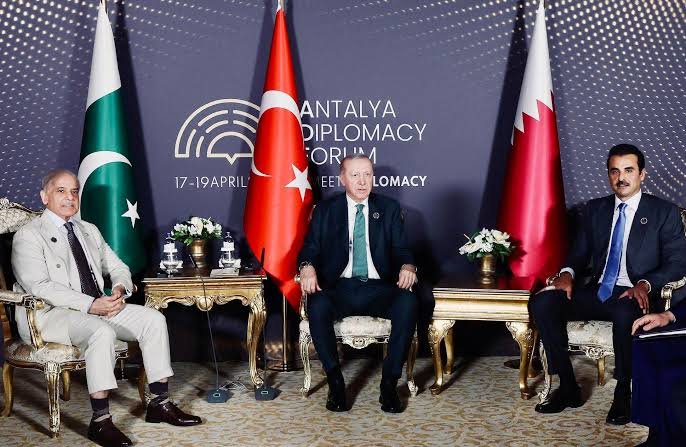
Israel’s greatest strategic mistakes have rarely come from failing to identify immediate threats. They have come from underestimating emerging ones. Before October 7, Hamas was widely viewed as contained. Before Hezbollah amassed more than 150,000 rockets, it was dismissed as a manageable nuisance. Today, another challenge is taking shape, not in tunnels or missile silos, but in diplomatic corridors stretching from Ankara to Doha and Islamabad. The growing Türkiye-Qatar-Pakistan alignment is steadily positioning itself as an alternative center of power in the Muslim world, and Israeli strategists would be making a serious mistake if they treated it as a temporary phenomenon.
The recent US-Iran agreement offered a glimpse of this emerging reality. For perhaps the first time in decades, a major diplomatic process affecting Israel’s security was shaped not by Israel or the US, but by a trio of states that have consistently positioned themselves among Israel’s harshest critics. Pakistan played the lead mediating role, Qatar maintained key communication channels, and Türkiye provided political backing. The significance extends far beyond the agreement itself. What matters is that these countries demonstrated an ability to influence the strategic direction of the region while Israel found itself largely watching from the sidelines.
For Israel, this should trigger serious concern because the alignment is not built merely on shared interests. It is increasingly built on shared ideology. President Recep Tayyip Erdogan has spent years transforming Türkiye into the principal champion of Islamist causes across the region. Qatar too has poured billions of dollars worth of investments in organizations and diplomatic activities which support the same ideology. Pakistan’s emergence under Field Marshal Asim Munir adds a new and potentially powerful dimension to this equation.
Munir is not merely another military commander. He is the first Pakistani army chief known to have formally memorized the Quran, a fact frequently emphasized by his supporters. Throughout his tenure, he has repeatedly framed geopolitical issues through an explicitly Islamic lens. His speeches on Kashmir, Gaza, and Muslim unity have resonated across the Islamic world. While previous Pakistani military leaders often projected themselves primarily as security managers, Munir increasingly presents himself as both a military leader and a guardian of broader Islamic causes.
That should matter because Pakistan is not Qatar. It is not a small state leveraging wealth. Nor is it Türkiye, a regional power constrained by economic difficulties and NATO obligations. Pakistan possesses one of the world’s largest armed forces, a rapidly modernizing military-industrial base, ballistic missile capabilities, and, most importantly, the only nuclear arsenal in the Muslim world. When a country with such capabilities begins acquiring diplomatic influence alongside ideological credibility, prudent strategists pay attention.
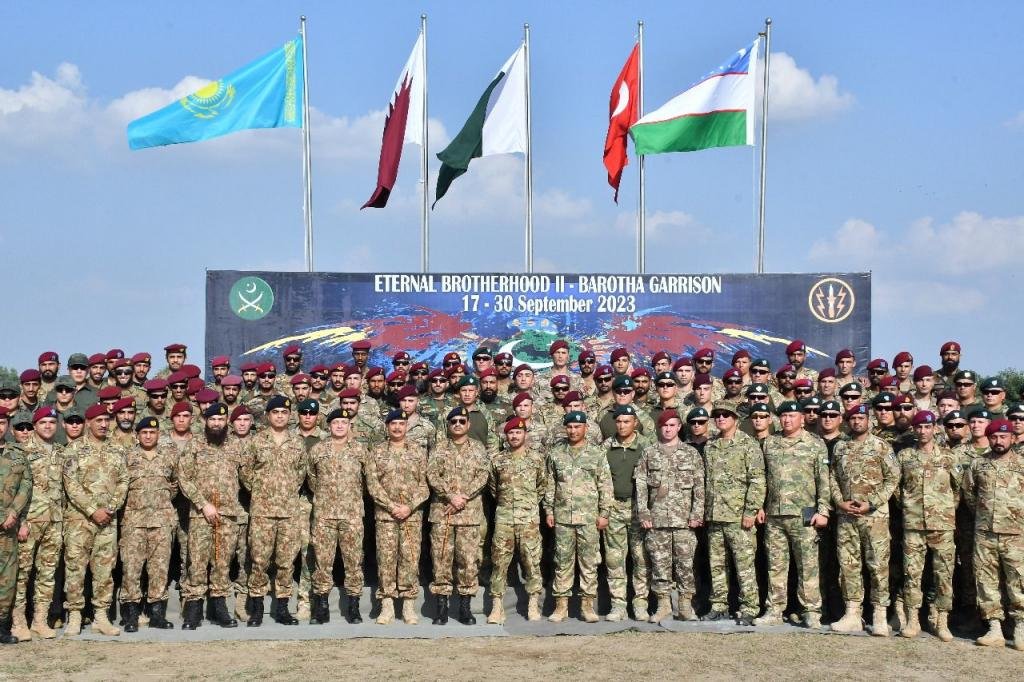
The danger for Israel is not that Pakistan, Türkiye, or Qatar will suddenly form a military alliance directed against the Jewish state. The problem is much deeper than that. What Pakistan, Türkiye, and Qatar are doing is positioning themselves in such a way that when the time comes for any of the Middle Eastern conflicts to be managed diplomatically, they will be able to shape the outcomes. In modern geopolitics, influence belongs not only to those who win wars but also to those who broker peace.Such a development has major implications for Israel.
Mediators have greater legitimacy. Mediators have greater access. Mediators have greater influence on the terms of agreements, rebuilding, regional policies, and international narratives. If Türkiye, Qatar, and Pakistan keep amassing diplomatic capital, there is little doubt that they will want to use that influence for their wider regional agenda, that often often diverges sharply from Israeli interests.The pattern is already evident. Türkiye is becoming more and more assertive in its diplomatic confrontations with Israel on the one hand, while building its military presence from Syria and Libya through the Eastern Mediterranean on the other.
Qatar is continuing to carve out its role as an absolutely necessary mediator in almost all regional conflicts, even as it builds ties with forces that despise Israel. Pakistan, meanwhile, is transitioning from a state primarily concerned with South Asia into a player increasingly willing to engage in Middle Eastern power politics.
The strategic concern becomes even more serious when considering the broader ecosystem forming around this alignment. Türkiye enjoys close relations with numerous Islamist movements. Qatar possesses immense financial resources and unmatched media influence. Pakistan brings military prestige and nuclear status.
Together, they offer a combination of ideological appeal, diplomatic reach, economic leverage, and hard power that few regional groupings can match.Moreover, this axis is emerging at a time when Israel’s traditional strategic advantages are facing new pressures. Relations with parts of Europe remain strained. American political consensus regarding Israel is becoming increasingly polarized. The Abraham Accords remain important but have not fundamentally resolved the Palestinian issue. Into this environment steps a bloc seeking to present itself as the voice of Muslim grievances and the architect of alternative regional arrangements.
The actual danger does not lie in the most recent deal with Iran. The actual danger lies in what this deal tells us: a new power center is being built in the Muslim world, an axis driven by Erdoğan’s ambitions, Qatar’s resources, and Asim Munir’s growing stature. If this trajectory continues, Israel may soon find herself facing not scattered opponents but a unified diplomatic front that can impact events in the region from many different angles at once.
By the time such an axis becomes impossible to ignore, the strategic landscape of the Middle East may already have changed. The question is whether Israel recognizes the warning signs now, or repeats the costly habit of recognizing threats only after they have become realities.