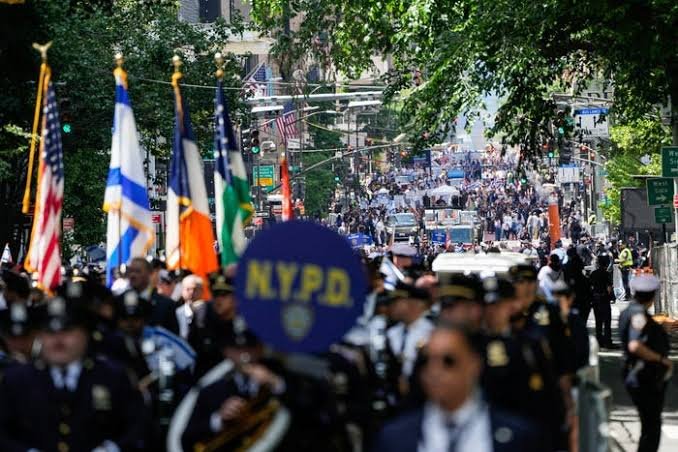
In the midst of the 2026 Israel Day Parade in New York, an unpleasant yet necessary dialogue is emerging among both Jewish and Israeli thinkers; the dialogue that addresses the issue of Jewish visibility and vulnerability in public space in the West. Where once there stood a regular and simple event of identity and community demonstration on Fifth Avenue, today there is something much more complicated, an event shaped by issues such as security, increased politicization and changing discourse on Israel in American society. The discussion no longer revolves around the success of the event but what this change means for Diaspora Jews in America.
From a purely factual perspective, the Israel Day Parade is still among the biggest manifestations of Jewish identity outside of Israel, hosting thousands of participants and onlookers each year. Nevertheless, the most recent parades were held in an exceptional security regime, which included cooperation with the NYPD, counterterrorism teams, rooftop observation posts, and crowd-control measures. According to recent statements by the NYPD, this parade was the only event of its kind which involved “the most comprehensive security plan of any recurring cultural event in the city’s calendar.” This level of protection reflects a broader reality: Jewish institutions across the United States now operate within a permanent security architecture that includes armed guards, controlled entry points, and intelligence monitoring.
There are significant sociological consequences resulting from this normalization of security. From something that was an exception when there was need for action in response to threats, it has become the norm. In large American cities, synagogues, Jewish institutions, and community centers engage on a regular basis with police authorities and private security companies. Data provided by American Jewish security agencies concerned with the number of antisemitic incidents indicates a steady increase in the reporting of such incidents from the year 2023, especially in the wake of any major geopolitical events involving Israel and Gaza. It is clear that there is a consensus on this matter, and it can be said that antisemitic incidents in America have become alarmingly high.
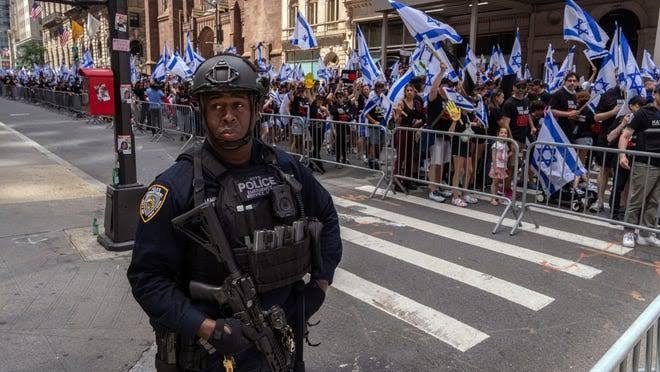
Against this backdrop, the symbolism of the parade takes on greater weight. For decades, it represented what sociologists often describe as “confident minority visibility”, a public assertion of identity within a pluralistic urban space. In 2026, however, that visibility is accompanied by an awareness of risk management. The presence of heavy security, while essential for safety, also reshapes the psychological experience of public identity. It introduces a paradox: the more visible the community becomes, the more visible its need for protection also becomes.
The political aspect makes this situation even more complex. Historically, Jewish communities in the U.S. have been working under the principle of bipartisanship with regards to their support of Israel. In recent times, though, there has been increasing political polarization in the United States when it comes to discussions about Israel and Zionism. Issues discussed at colleges and universities, city councils, and civil society have included criticism of the actions of the state of Israel, sometimes resulting in more general hostility towards Jews.
But it is crucial not to exaggerate the character of this process. The American Jewry is still part of the most secure and tightly knit community of its kind anywhere on Earth. Prominence in government, business, mass media, and universities is still characteristic of American Jewry. Great cities like New York retain their position as major centers of Jewish culture unparalleled anywhere in the Diaspora. But the combination of integration and insecurity has defined the character of modern Jewish existence in America.
The imagery of heavily protected public events can evoke historical associations, but analytical caution is necessary. Contemporary security arrangements are not evidence of institutional exclusion, but rather responses to a documented rise in targeted threats against public gatherings. In this sense, the state’s role, particularly through agencies such as the NYPD, is not one of separation but of protection. The presence of armed security at public events is now a standard feature of urban counterterrorism policy across multiple communities in the United States, not unique to Jewish life.
However, perception is just as important as policy. For many participants and onlookers, the juxtaposition of celebration and protection raises concerns about communal confidence in the future. When identity expression cannot be separated from the construction of safety infrastructure, it is bound to influence community perceptions of their place in society.
The future trajectory will, therefore depend on several variables: the evolution of antisemitism in digital and physical spaces, the direction of American political polarization, and the ability of communal institutions to adapt to sustained security demands without normalizing fear. Equally important will be the capacity to preserve public Jewish identity in a way that remains both visible and resilient.