
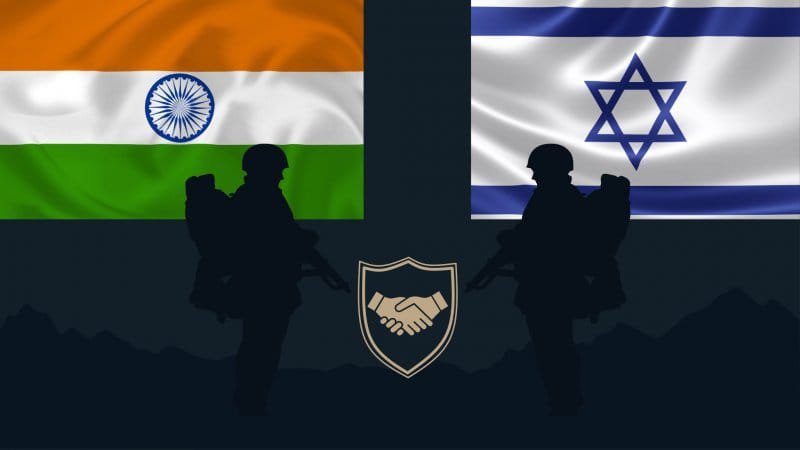
The emerging axis between Israel and India has transcended the conventional bounds of a strategic defense partnership. It is rapidly evolving into a profound ideological alignment, rooted in a shared perception of national identity, regional security, and the existential challenges posed by radical ideologies. While the foundation of this bond is built on concrete pillars, shared intelligence, advanced weaponry, and robust economic cooperation, its acceleration under Prime Minister Benjamin Netanyahu and Prime Minister Narendra Modi reflects a deeper synergy between Israel and India.
For decades, India maintained a cautious, often distant stance toward Israel, largely constrained by its historical support for the Palestinian cause and the domestic political requirements of managing its significant Muslim population. However, that era has definitively ended. Under the leadership of Prime Minister Modi, India has moved beyond the “balancing act” that once defined its Middle East policy. This shift is not merely pragmatic; it is a calculated alignment of national interests with a partner that shares an ideological “othering” of radical Islamic extremism.
The convergence of interests is starkly visible in the field of defense. The reported negotiations between Israel’s Rafael Advanced Defense Systems and Indian manufacturers to establish an assembly line for Iron Dome interceptors represent a milestone. This is not just about procurement; it is about building a scalable, resilient supply chain that serves both nations. By localizing production under India’s “Make in India” initiative, Israel secures a strategic manufacturing hub that is insulated from the political volatility often found in Western markets. For Israel, this provides a vital insurance policy, ensuring that essential defensive munitions can be replenished rapidly during periods of intense regional conflict.
Beyond the hardware, the partnership is fueled by a shared political temperament that critics and proponents alike have termed an ideological “othering” of perceived internal and external threats. Both nations find themselves grappling with the complexities of managing domestic security in the face of what they describe as radical ideological encroachment. The governing philosophies of the BJP in India and the current administration in Israel emphasize the protection of ancient cultural heritages against perceived modern distortions.
This ideological affinity extends to the emotive and often controversial topic of reclaiming cultural and religious landscapes, a cornerstone of the solidarity between the two regimes. In both nations, there is a powerful political narrative centered on “reclaiming” a lost or desecrated past, viewing the physical landscape as a testament to historical identity. In India, this has manifested in a massive wave of efforts to restore and reclaim sites considered sacred in Hindu tradition, efforts framed as a long-overdue restoration of indigenous civilization after centuries of foreign or colonial rule. This includes high-profile movements to reclaim historical sites like the former Babri Masjid, which was replaced by a grand Hindu temple, and ongoing grassroots campaigns targeting other monuments like the Taj Mahal, which some groups claim sits atop ancient Hindu architecture. For the supporters of these movements, these actions are not seen as destruction or political aggression, but as a moral imperative to return the land to its original cultural stewards.
Similarly, in Israel, the discourse around historical sites and the right to ancestral land is central to the Zionist narrative. The act of reclaiming sites, whether it involves historical landmarks in the heart of ancient territories or the preservation of religious heritage, is viewed as a moral obligation to restore Jewish history. By reframing their national projects as a struggle to reclaim an ancestral home from those they view as occupiers or historical usurpers, leaders in both Israel and India have successfully mobilized their bases. They have created a new kind of transnational solidarity where the “civilizational” struggle is seen as a shared endeavor against those who would erase their history.
Critics argue that these policies marginalize Muslim minorities and exacerbate communal tensions in both countries, threatening the secular foundations of their respective states. However, the political reality is that this “civilizational” lens has become a rallying cry for both regimes. By prioritizing the restoration of their cultural heritage, they have created an ideological framework that transcends simple trade deals and military hardware.
This ideological affinity has manifested in a dramatic shift in public sentiment. Since the Hamas-led attacks on October 7, 2023, India has emerged as one of Israel’s most vocal supporters outside of the Western sphere. While many global powers adopted a posture of equivocation, the Indian government, and notably, a significant portion of its citizenry, rallied behind Israel with fervor. Social media platforms became arenas for this solidarity, with Indian users expressing overwhelming support for Israel’s right to self-defense. This public mobilization signals that the partnership is no longer just a project of the political elite; it is gaining ground in the national consciousness of both countries.
Critics often argue that this alignment risks alienating India’s traditional partners in the Arab world, yet New Delhi has demonstrated a remarkable ability to compartmentalize its relations. India continues to maintain vital economic ties with the Persian Gulf while simultaneously deepening its military and intelligence integration with Israel. For Israel, this is a masterclass in modern statecraft, demonstrating that a nation can pursue its core security interests while maintaining a complex, multi-layered foreign policy.
Ultimately, the partnership is not just about the exchange of drones, missiles, or surveillance satellites. It is about a shared vision of a multipolar world where Israel and India stand as bastions of stability in their respective regions. The way India, under the current ruling party, has left behind the long-standing stance of solidarity with Palestine held by its founding leaders and adopted a realistic, principled approach against Muslim extremism is something for which Israel should be deeply grateful. Despite all the so-called humanitarian agenda pressures, New Delhi has stood firm with the realities of the security landscape, even while navigating the complexities of its own large Muslim population. By aligning their technological prowess with a unified ideological perspective, Israel and India are creating a model of cooperation that is arguably more durable than any formal treaty. In an unpredictable world, this is a partnership that both sides can rely on for the long term.