By Noam Shalev
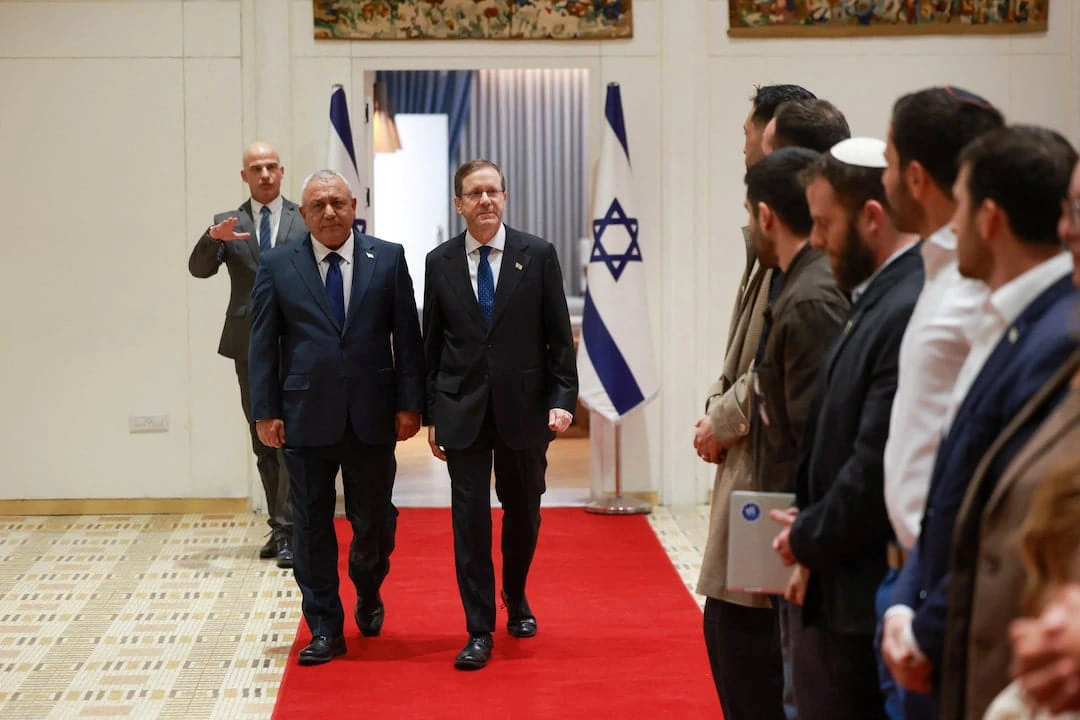
The arithmetic of Israeli coalition building has reached another perilous moment following the October 2026 elections. Armed with 67 recommendations to Prime Minister Benjamin Netanyahu’s 46, Yashar leader Gadi Eisenkot arrives at the President’s Residence practically assured of receiving the first mandate from President Isaac Herzog. Yet securing the legal mandate to form a government isn’t quite the same as swearing one in. As Eisenkot steps into his 28 day negotiation window, he’s facing a mathematical and ideological maze where every available path to a 61 seat majority comes with severe political costs.
The core of the dilemma lies in the composition of the incoming 25th Knesset. Eisenkot’s change bloc, comprising Yashar with 21 seats alongside partners B’Yachad under Naftali Bennett, Avigdor Liberman’s Yisrael Beiteinu, and Yair Golan’s The Democrats, commands just 48 seats. Netanyahu’s right wing and religious alliance remains stuck at 53. Because neither traditional Zionist alignment holds an independent majority, the balance of power sits with two distinct groups: the ultra Orthodox parties holding 18 seats, and the two Arab led slates holding 19.
The most visible tactic emerging from the change camp involves courting the Haredi factions, specifically United Torah Judaism. UTJ’s decision to withhold an endorsement for Netanyahu during presidential consultations was a significant rupture in the right wing bloc. Party leaders signaled that their support remains tied directly to legislative concessions on military conscription exemptions and the removal of financial penalties for non enlistment. Liberman, long defined by his secular hawkish stance, surprised observers by publicly acknowledging on social media that politicians must show flexibility and accept painful compromises on Haredi draft legislation to end the Netanyahu era.
However, constructing a viable government around this axis presents immediate structural obstacles. Liberman simultaneously declared his opposition to any minority government, effectively requiring the inclusion of both UTJ and Shas to reach 61 seats. Yet Shas leader Aryeh Deri remains firmly aligned with Netanyahu, having endorsed the incumbent prime minister during consultations. Furthermore, any deal that grants sweeping exemptions to Haredi men directly violates explicit campaign pledges made by every change bloc leader. Internal dissent has already surfaced, with Yisrael Beiteinu MK Dan Illouz publicly insisting that compromising on draft legislation remains unacceptable to the party’s voters.
The alternative mathematical route relies on cooperation with the Arab led parties, Ra’am and the Joint List. While Ra’am under Mansour Abbas previously participated in the 2021 coalition, relying on their 19 combined seats creates profound friction within the change bloc itself. Liberman explicitly ruled out supporting any cabinet that depends on abstentions or votes from Ra’am or the Joint List. Additionally, Eisenkot himself previously stipulated that joining his government requires recognizing Hamas as a terrorist organization and embracing the core principles of a Jewish and democratic state, conditions that the Joint List’s secular nationalist components have historically rejected.
This leaves a national unity arrangement between the change bloc and Likud as a theoretical third option, though all four opposition leaders have repeatedly ruled out sitting under Netanyahu. With Netanyahu facing a weak 53 seat position, some analysts view Eisenkot’s overtures toward the Haredi parties as a tactical move to squeeze Likud’s leverage rather than a durable coalition plan. If negotiations collapse across all fronts, the default outcome isn’t unclear: it’s political stagnation, leaving Netanyahu as caretaker prime minister while heading toward a sixth election cycle.
The broader operational implications of this deadlock reach directly into Israel’s security and foreign policy architecture. Facing open ended regional conflicts, unresolved hostage negotiations, and escalating tensions across multiple fronts, the defense establishment urgently requires a stable, fully empowered cabinet capable of passing long term war budgets and managing critical strategic realignments. Operating under a caretaker administration limits the state’s capacity to execute decisive policy shifts or rebuild international leverage at a moment of mounting global scrutiny.
Ultimately, Eisenkot’s quest for the premiership underscores the fragile state of Israeli governance. Securing 67 endorsements demonstrated a shared desire among a majority of lawmakers to change executive leadership, but translating that shared objective into a functioning, stable cabinet requires navigating irreconcilable promises on conscription, civil integration, and national security. Without unprecedented flexibility from key party leaders, the mandate to form a government may end not with a new coalition in Jerusalem, but with continued paralysis.
About the Author
Noam Shalev is a Political Affairs Commentator covering Israeli government policy, US-Israel relations, coalition politics, and diplomatic engagement across the Middle East.