
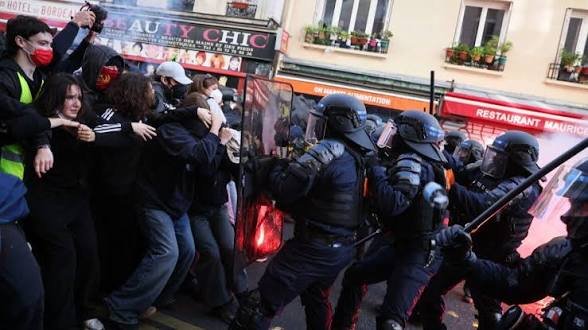
Every time severe unrest breaks out in a Western democracy, it is like flipping an old, toxic switch in the collective mind, a reflex that is deeply rooted and, honestly, tough to shake. So, when riots and protests gripped French cities over soaring prices and mounting economic stress, you could almost set your watch to the flood of conspiracy theories pouring into online spaces. They popped up fast. In just three days, researchers at the Combat Antisemitism Movement (CAM) counted at least 1,384 separate posts on X (what people used to call Twitter), all falsely accusing Israel, Mossad, and Jewish communities of staging the chaos, the fires, the looting, the street clashes in Paris and beyond.
This is not new. History is packed with examples: whenever a country hits serious crisis, polarization, economic hardship, whatever, it is almost automatic for some people to point fingers at Jewish communities. CAM is Antisemitism Research Center dug into this and found an ugly mix at work. On one side, you have got extremists on the left and right, and then radical Islamist voices too, all feeding each other. High traffic accounts, the kind that usually drive conversations, began churning out wild accusations. You would see messages claiming Mossad is burning France right now or calling the riots a civil war orchestrated by Jewish elites. Others dusted off those old antisemitic stories, like accusing President Emmanuel Macron of being in league with the Rothschild banking family. Far right influencers with massive followings went so far as to post: The Jews did this to France. Do not let them do it to America.
What should really make people stop and take notice is how routine all this has become. It is not a one off. CAM pointed out that this was the fourth time in just three months that major events got twisted into antisemitic conspiracies online. Look at the pattern: the migrant crisis in Ceuta, the anniversary of September 11, an attempted hijacking of a plane headed to Ben Gurion Airport, it does not matter. If a crisis hits the headlines, the usual circle of radical accounts starts weaving in Jewish conspiracies almost instantly.
Social media is role in all this? It is not just background noise. These platforms are not passive, they accelerate and even profit from incitement. The CAM study showed that X Premium accounts, the ones with blue checkmarks, were not just commenting, they were leading the charge, spreading some of the most extreme messages. Some even called openly for violence, deportation, and worse. And because the algorithms boost verified accounts, these posts got millions of eyeballs, fast. Sacha Roytman, CAM is CEO, did not mince words: social media companies are rewarding the people who spread hate, not shutting them down, and they are putting real people in danger by doing it.
And this is not just an online issue, far from it. The wave of digital scapegoating turns into a direct threat for Jews living outside of Israel. Let us be clear: hate that spreads online does not stay there. It spills out into the real world, raising the danger level for schools, synagogues, and community centers. In France, during the turmoil, reports of vandalism at Jewish institutions started coming in almost immediately. The line from digital theory to real world attack? It is terrifyingly short. When people are bombarded over and over with the message that a minority secretly controls or sabotages a nation, violence follows.
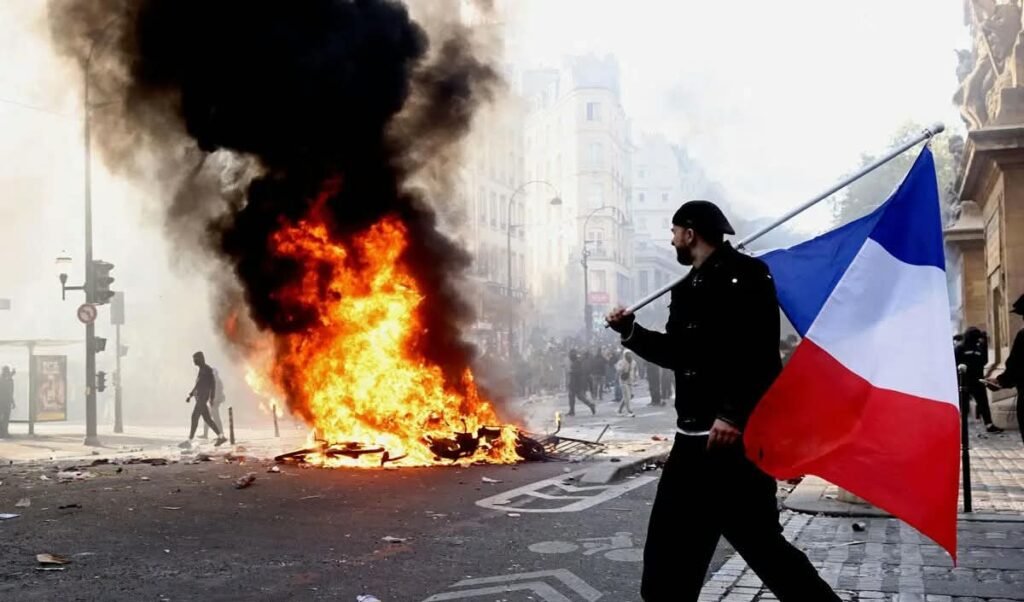
But there is another layer here, a failure that sits squarely on the shoulders of European leaders and the broader public conversation. Too many have shrugged off the rise of antisemitism, treating hate online as a side issue, not the challenge to democracy that it really is. Yet when big chunks of the public buy into lies that their institutions are run by some secret, foreign conspiracy, trust in democracy unravels. And the normalization of these anti Jewish and anti Zionist stories in politics just gives cover to radicals looking to tear things apart.
Fixing this is not simple, but it is urgent. First, Western governments have to hold tech companies to account, both legally and financially, when their algorithms spread hate or incite violence. Letting companies profit from extremist engagement, all under the banner of free speech, puts real lives at risk, it is that straightforward.
Second, law enforcement across Europe needs to get much more aggressive, going after both the rioters trashing public spaces and those online who are stirring up violence against minorities. Brushing off digital hate as protected speech, when it so clearly leads to real attacks, is just lazy, and dangerous.
Finally, Israel and international Jewish groups have to keep tracking, documenting, and calling out these digital hate networks. Being defensive is not enough anymore. The fight must include aggressively exposing the trolls, the bot networks, and the ideologues who seize every crisis as a chance to target Jews at home and abroad.
What happened in France should make the lesson obvious: the wellbeing of Jewish communities and the stability of Western democracies are deeply connected. When conspiracy theories crowd out reason in public life, everyone loses. Pushing back against the scapegoating of Israel and the Jewish people is not just about protecting one group. It is about upholding democracy, and that is in everyone is interest.
About the Author
Eitan Levi is a Security and Geopolitical Analyst with expertise in Israeli defence strategy, Iran’s regional operations, Middle Eastern power rivalries, and Israel’s security partnerships.