
By Noam Shalev
The clash between former Israeli ambassador Ron Dermer and American conservative media host Tucker Carlson has moved far beyond online sparring into a sharp battle over information warfare, Republican foreign policy, and Israel’s standing in Washington. On Sunday, November 22, 2026, Dermer accused Carlson on X of earning an estimated $23.5 million a year from the overseas promotion of his posts. Dermer wrote that antisemitism had become Carlson’s revenue model, calling his audience “Tucker’s Suckers”. Earlier in November on the podcast Chicks on the Right, Dermer pointed to social media tracking data showing Pakistan first and Qatar second in boosting Carlson’s posts. He argued that Americans who follow Carlson for his “America First” pitch should know who helps his views reach them. For an Israeli reader watching strategic ties with Washington fray, the dispute exposes a deeper problem than a viral feud. It shows how online amplification, shifting regional pacts, and domestic American divisions are turning Israel into a contested issue inside a political movement Israeli leaders spent years cultivating.
Dermer’s warning touches a genuine vulnerability in modern media ecosystems, even if his numbers invite sharp questions. Coordinated online networks and foreign promotion can supercharge polarizing claims across borders without a direct wire transfer from a foreign ministry. Algorithmic feeds reward outrage and tribalism, allowing outside actors to amplify divisive narratives at scale while maintaining plausible deniability. When Dermer singles out Pakistan and Qatar, he speaks to real anxieties in Jerusalem. Doha exercises major diplomatic and media influence across Western capitals while acting as a key regional mediator, shaping perceptions through state backed outlets and strategic lobbying. Islamabad has also expanded its diplomatic and defense ties across the Middle East amid shifting regional security arrangements, deepening partnerships that challenge traditional alignments. Even without proof of direct state payments to Carlson who stated in July that he never took money from Qatar or any other government and co owns his company with his college roommate suspicions of foreign amplification highlight how outside actors can exploit American polarization. Foreign players do not need to invent domestic grievances from scratch; they simply identify fault lines over foreign interventions, spending, and sovereignty, then push content that widens those fractures.
At the same time, Dermer’s approach carries clear risks when pursued publicly without verifiable proof. Journalist Glenn Greenwald quickly challenged Dermer on Sunday evening over how an Israeli official could cite American government estimates about a private American citizen’s earnings. Dermer did not name the social media analytics firm in his podcast remarks, nor did he explain how country rankings translated into a $23.5 million annual figure. That lack of transparency turns a serious conversation about information manipulation into an easy target for counterattacks. When Israeli officials make sweeping claims online without releasing clear methodology, critics seize on the gaps to portray Jerusalem as heavy handed, partisan, or conspiratorial. In an environment where Americans on both the right and left view foreign influence with suspicion, precision and restraint carry far more weight than sharp insults. Publicly attacking a prominent domestic media figure without rock solid, independently verifiable evidence risks alienating persuadable viewers who might otherwise listen to a sober analysis of online manipulation.
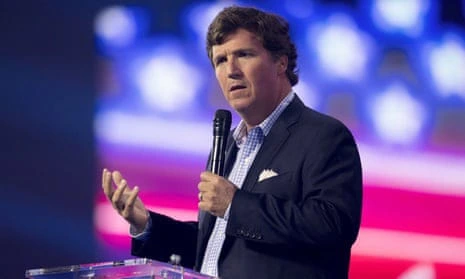
The timing of this clash underscores how high the stakes are for Israel right now. Just before the American midterm elections, Carlson claimed on X that Prime Minister Benjamin Netanyahu was pressing President Donald Trump to launch a nuclear strike against an Iranian facility near Natanz and Pickaxe Mountain. Trump had publicly discussed conventional options for striking the site and had previously ruled out using nuclear weapons against Iran. Carlson offered no proof for the claim, citing an “informed observer” at a moment when the prolonged conflict with Iran had already imposed heavy financial and military costs on Washington. Sensational claims about nuclear escalation do not need to be accurate to cause damage. They alarm war weary Americans, cast Israel as a driver of wider war, and feed isolationist sentiment inside the conservative movement. In a high stakes election cycle, fear of entanglement and escalation travels faster than nuance, and a single viral accusation can linger in voters’ minds long after it is refuted.
Those isolationist currents are no longer confined to the margins of the American right. At the Republican Jewish Coalition summit in Las Vegas in August, chairman Norm Coleman criticized Carlson for giving a platform to Holocaust deniers. Yet Vice President JD Vance, a longtime friend of Carlson’s, declined to criticize him by name at the same gathering. That hesitation reflects a real shift inside the Republican Party. For years, Israeli leaders treated strong Republican backing as a steady pillar of national security, anchored by shared strategic goals and broad ideological alignment. Today, influential voices within the “America First” camp openly question open ended commitments in the Middle East, arguing that foreign crises distract from domestic priorities and economic strain at home. Meanwhile, prominent figures show little desire to break with media hosts who appeal to anti establishment and isolationist audiences, creating a political calculus where defending Israel is weighed against keeping populist coalitions intact.
For a country navigating post election coalition talks in Jerusalem and trying to rebuild its international standing, responding to hostile narratives requires more than trading jabs on social media. Exposing foreign disinformation and bad faith attacks is necessary when falsehoods threaten national security and distort public debate. Yet name calling alone will not persuade skeptical conservatives or reassure worried Americans; in fact, abrasive rhetoric can reinforce the very caricature of foreign meddling that critics use to push back against closer ties. Israel’s strongest answer in a noisy information war remains verifiable facts, disciplined messaging, and steady statecraft that gives allies confidence in its judgment rather than reasons to doubt it. By grounding arguments in clear evidence, engaging directly with legitimate concerns about costs and strategic limits, and focusing on concrete security cooperation, policymakers can defend Israel’s interests far more effectively than any viral exchange ever could.
About the Author
Noam Shalev is a Political Affairs Commentator covering Israeli government policy, US Israel relations, coalition politics, and diplomatic engagement across the Middle East.