
Picture Benjamin Netanyahu standing at the UN, staring out over rows of empty seats after a mass walkout. That scene sums up exactly where Israel stands internationally right now: cut off, isolated, and defiant. The surprising thing isn’t the isolation, though, it’s how Netanyahu has decided to handle it. Instead of trying to smooth things over, he’s turned this diplomatic cold shoulder into a political weapon back home. Isolation, in his telling, isn’t a weakness. It’s evidence of Israel’s moral strength and resilience, proof that standing alone is part of the nation’s destiny.
This is a sharp break from where the country’s leaders once stood. When Ben Gurion declared Israel’s independence in 1948, he wasn’t looking to go it alone forever. He wanted a Jewish state recognized by the world, the kind of country that fits into the international system and follows the rules of global law. Years later, Rabin came along and faced down that old, gloomy idea, “a people that dwells alone”, and said, no, Israel can be part of the world. In 1992, Rabin told Israelis, “No longer are we necessarily ‘a people that dwells alone,’ and no longer is it true that ‘the whole world is against us.’ We must overcome the sense of isolation that has held us in its thrall for almost half a century.” Integration, not isolation, was the vision.
But Netanyahu has flipped that vision on its head. Confronted with a public hardened by decades of violence and tired of judgment from abroad, he’s offering something different: Israel as a kind of Sparta, tough, self reliant, and ready to stand alone against the world. Every time international institutions or foreign leaders criticize Israel, he tells voters it’s just proof that the world’s always been against them. He wraps each walkout, each stinging resolution, into his message: Only he can keep the country strong when everyone else walks out of the room.
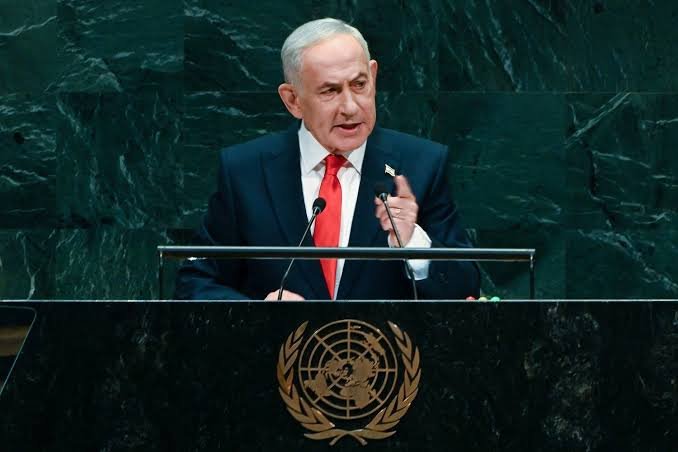
That new philosophy was center stage in New York. Diplomacy took a back seat to drama. Netanyahu didn’t bother much with the usual cluster of side conversations, apart from hanging out with the likes of Argentina’s president, Javier Milei, one of the rare international allies still interested in public photos. Inside the assembly, it was pure campaign theater. Prop in hand, a Starlink dish, he bragged about Israel’s technological prowess and military operations, tossing in references that would hit home with his base. He even went after absent diplomats and local critics on American soil, such as New York Mayor Zohran Mamdani, leaving no doubt who his audience really was.
Then there was the moment he fired off accusations of colonialism back at Europe, targeting France and the UK as if to say, “We won’t take lectures from you.” It’s a combative approach, but it’s not accidental, it’s a calculated election tactic. The more the world snubs Israel, the more Netanyahu presents himself as the one leader tough enough to push back. He’s recast growing isolation not as a diplomatic defeat, but as a badge of honor, a sign that Israel must stand firm, led by someone willing to reject the opinions of the outside world.
But this approach isn’t free. The costs, real costs, are piling up. Israel has always balanced military power with a crucial second pillar: rock solid alliances, especially with the United States. The military is still sharp, packed with high tech capability, but the diplomatic foundation doesn’t look nearly as steady these days. Support from both American parties used to be automatic. Now it’s not. Israel’s relationships in Europe, particularly Paris and London, are under strain. Efforts to normalize ties in the wider Middle East seem to be going nowhere fast.
By embracing the role of a nation under siege, Israeli leadership runs the risk of forgetting that political survival and national interest aren’t the same thing. Sure, you can stay militarily strong on your own, invest in the latest technology, stick to deterrence, but long term safety needs partners, trade, and intelligence sharing. If you start to see the world as nothing but enemies at the gate, you alienate the allies who keep you ahead.
And this isn’t just an external problem. The siege mentality seeps into Israel’s own society. People there have always prided themselves on strength, but also on belonging to the wider world, pioneers in technology, science, and global business. Recasting Israel as a fortress risks the kind of self reinforcing isolation that drives away investors, innovators, and even homegrown talent who thrive on openness. Holding up Sparta as the model might pump up morale in tough times, but it brings long term consequences, socially, economically, and culturally.
Now, as another election looms, Israelis aren’t just choosing between candidates or party platforms. They’re choosing between two radically different directions for the country’s future. Rabin’s idea, a state integrated into the world, confident and recognized, or Netanyahu’s fortress, proud and alone. Campaign slogans about “standing alone” might work for rousing a crowd, but as long term strategy, the risks are clear: you end up more isolated, less secure, and less able to shape your own fate in a chaotic world.