By Noam Shalev
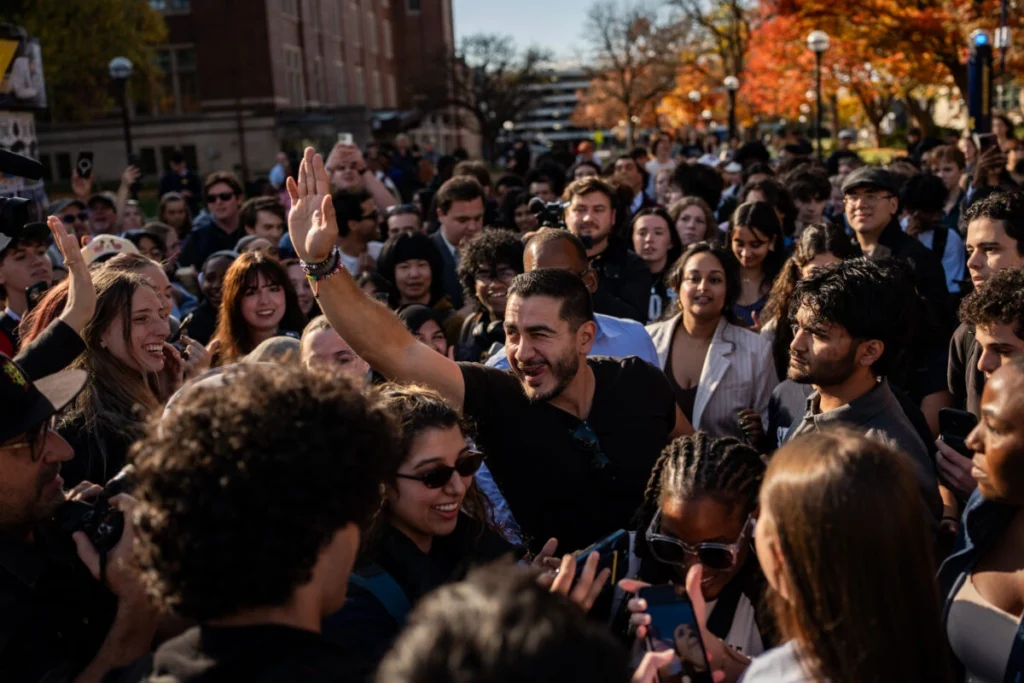
Abdul El Sayed’s win in Michigan’s Senate race sent shockwaves through Israel. El Sayed beat Republican Mike Rogers in a state that’s often up for grabs, becoming the first Muslim American to hold a seat in the upper chamber. For Israelis watching all this unfold, seeing a senator push for cutting back US military aid to Jerusalem, and campaign alongside controversial figures like Hasan Piker, is unsettling. But what really threw people off was the polling after the election. The survey by Mercury Public Affairs for The Jewish Majority showed El Sayed pulled in 50 percent of Michigan’s Jewish vote. That’s way down from the usual 75 to 80 percent that Democrats expect, and Rogers outperformed El Sayed among Jewish voters in Oakland County, picking up 52 percent compared to El Sayed’s 39. Even so, half the Jewish voters chose a candidate with a platform upending core Israeli security interests.
Honestly, this isn’t just a Michigan thing. Flash back to November 2025, democratic socialist Zohran Mamdani wins the mayor’s race in New York City. According to CNN exit polls, he grabbed about a third of the city’s Jewish vote even though he’s known for calling Israel an apartheid state. Put these two wins together and you start to see something bigger: A cultural and ideological split between the world’s two largest Jewish communities is getting wider and wider. As clinical psychologist Irwin J. Mansdorf pointed out in The Jerusalem Post, Israelis often see this as abandonment or flat out betrayal, while many progressive American Jews see their choices as a reflection of their Jewish values.
Bridging that gap takes more than just talking past each other, it means recognizing how differently Israelis and progressive American Jews define their Jewishness and what keeps them up at night. For Israelis, Jewish identity is about having a nation, a home you defend, and the kind of physical safety you only get through sovereignty. Living under the constant shadow of Iranian missiles, Hezbollah’s arsenal, and the trauma of October 7, Israelis see a strong Jewish state supported by US security aid, a solid $3.8 billion a year, as not just policy, but survival. It’s the difference between daily normality and existential threat.
For many progressive American Jews, it’s a whole other story. Their Jewish identity comes out in supporting universal ethics, fighting for social justice, and protecting civil rights here at home. Their political priorities revolve around healthcare, reproductive rights, action on climate, minority protections, and pushing back against Trump and the Republicans. During Michigan’s campaign, with Trump and Vice President JD Vance leading relentless attacks, lots of Jewish Democrats saw voting for El Sayed as a stand for pluralism and democracy in the US. Even after El Sayed’s controversial “hurt people hurt people” comment following a terrorist attack at Temple Israel in West Bloomfield, half of Michigan’s Jewish voters put party loyalty and domestic issues ahead of foreign policy.
And then there’s the way both communities think about staying safe. Israelis count on military strength, intelligence, and secure borders to keep them protected. Progressive American Jews, meanwhile, lean on intersectional alliances, joining forces with other marginalized groups, believing solidarity is the best shield against antisemitism in the US. But there’s a catch. Sometimes those progressive partners see the world only through the lens of oppressors versus oppressed, casting Israel automatically as an oppressor and turning anti Zionism from a critique into a matter of moral obligation.
All this isn’t just a passing trend, it’s built into the numbers. A Pew Research Center survey in May 2026 showed Americans’ favorable views of Israel down to 52 percent from 67 percent in 2022. Among people under 30, only 32 percent like the Israeli people, while 58 percent favor Palestinians. The numbers are most dramatic among young Democrats: 72 percent view Palestinians favorably, compared to only 26 percent for Israelis. For younger progressive Jews, the pressure to distance their Jewish identity from support for Israel just keeps growing.
Some Israelis try to comfort themselves by blaming this gulf on Netanyahu’s long stint as prime minister and his rocky relationship with Democrats in the US. But, honestly, that’s missing the mark. Israeli leaders from across the spectrum, like Yashar leader Gadi Eisenkot, who’s got the mandate to form Israel’s next government, and former prime ministers Naftali Bennett and Avigdor Liberman, all agree on the basics: tough stances on Iran, maintaining security in Gaza, and keeping up deterrence. Changing the person at the helm in Jerusalem isn’t going to magically fix a divide that’s about what it means to be Jewish and who gets to decide what solidarity looks like.
American Jewry isn’t one block. Millions of American Jews still care deeply about Israel, fight against anti Zionist narratives, and even switch their votes when it matters, as seen with the 23 percent of Democratic Senate voters in Michigan crossing over to support Rogers in 2026. But ignoring the big cultural shift happening among progressives would be a huge mistake for Israel. The numbers out of Michigan and New York aren’t just statistics, they’re a warning. The shared history, holidays, and ancient texts don’t cut it anymore when it comes to guaranteeing mutual understanding between Israel and larger segments of American Jewry. Something’s changing, and it’s not going away.
About the Author
Noam Shalev is a Political Affairs Commentator covering Israeli government policy, US-Israel relations, coalition politics, and diplomatic engagement across the Middle East.