
By Israel Dispatch
As military planners in both Jerusalem and Washington sharpen their plans for the possibility of a third major confrontation with Iran, the balance of power across the Middle East is facing pressure unlike anything it has seen before. The joint air operations in early 2026 really drove home just how much control the Allied forces can exert from the skies. Think about it: over two hundred Israeli fighter jets, not to mention full American strike wings, moved with near absolute freedom. They took apart radar grids, shut down air defense batteries, and hammered away at high value military targets one after another across several theaters. It was an overwhelming show of force. But, like any good strategist will tell you, the fact that you own the sky for a few days does not mean you have won the bigger, long term fight. The much harder job is figuring out how to neutralize weapons buried so deep that even the heaviest bombs barely scratch the surface.
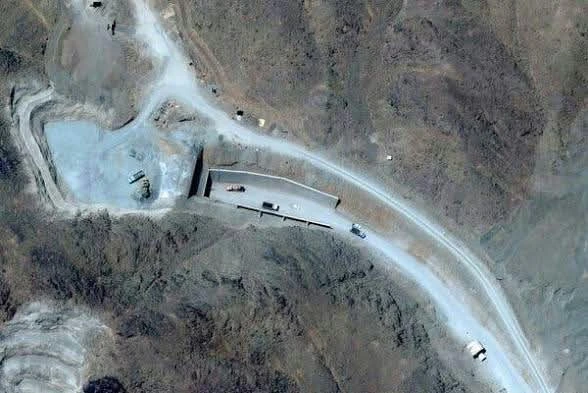
And this brings everything back to Pickaxe Mountain. That is the code name analysts use for a highly fortified underground facility tucked near Iran’s Natanz enrichment complex. Carved out of unyielding granite, it is not just another bunker. This place is a leap forward in underground engineering, a fortress in the literal sense. From what satellite images show, Pickaxe still is not fully operational, but even so, its extreme depth turns it into a real headache for targeting teams. There is a debate raging right now: can even America’s biggest bunker buster, the massive 30,000 pound MOP, which can rip through sites like Fordow, actually get deep enough to obliterate Pickaxe’s core? A lot of people are not convinced.
If the Iranians move highly enriched uranium, advanced centrifuges, or their weaponization gear into these granite vaults, they could lock in a nuclear breakout capability in almost complete secrecy. It would not just be hard to reach, it would be close to untouchable. That is why analysts at the Institute for Science and International Security are urging military planners to get creative. Instead of only dropping big bombs, they are looking at ways to target weak points like the mountain’s main ventilation shafts and tunnel entrances, both to the north and south, east and west. The idea is simple but ambitious: block off all access points and suffocate the facility. Even if the main halls survive, you could trap the machines, the material, and, if you are lucky, the project itself. It is not foolproof, but it is another lever to pull.
Still, Pickaxe and the nuclear infrastructure are just one piece of Iran’s broader strategy of buried assets. The 2026 campaign taught the Allies a tough lesson: Iran’s mobile, underground ballistic missile arsenal is a persistent, slippery threat. Sure, airstrikes can force tunnel collapses, but they only buy you a little time. Iranian engineers are quick as lightning. Sometimes, within hours, they clear rubble, patch up the site, and get those launchers ready to go again.

They have also shifted their missile tactics. Instead of firing huge barrages all at once, their crews have gone the other way, they keep it small and steady, launching salvos from scattered teams, over and over. That constant, unpredictable pressure wears down even the best air defenses. Interceptor stocks run low. Civilian infrastructure, power grids, ports, fuel reserves, gets battered. Add to that Iran’s threats to close off the Strait of Hormuz, hit Gulf state pipelines, and strike coalition bases, and you are left with a regime that can still cause major headaches for everyone in the region, even while it is under heavy aerial assault.
There is a real split in thinking among planners about how far and how long the next operation should go. The White House has made it clear they want something short and sharp, a three day, high intensity blitz, to avoid rattling the region’s already shaky economies. But Israeli defense officials are not buying it. They are convinced that a quick campaign will not force Iran to rethink its strategy in any meaningful way. If those core nuclear materials stay put, buried under tons of granite, and if mobile missile teams survive and rearm once the jets fly home, then nothing really changes. As soon as the shooting stops, the threat comes roaring back.
That is why some in Israel’s senior defense circles, including former Defense Minister Yoav Gallant, argue that if you want real, lasting results, you need to think long term, even if that means committing to longer campaigns and sending specialized teams to tackle the toughest, deepest sites on the ground. There is no shortcut.
As Israeli leaders try to square ambition with reality, it is becoming clear that success cannot just be measured in counts of targets destroyed or missiles intercepted. Another war with Iran cannot just be about delaying the inevitable. Real victory means closing down, not just postponing, the nuclear breakout threat, ending the constant barrage from missile teams, and changing the power game in the region for good. Anything less, and you are stuck in a loop: heavy costs, recurring dangers, and a war that never quite ends.
About the Author
Israel Dispatch provides authoritative, non-partisan analysis on Israeli security, political dynamics, regional geopolitical shifts, and sovereign foreign policy.