
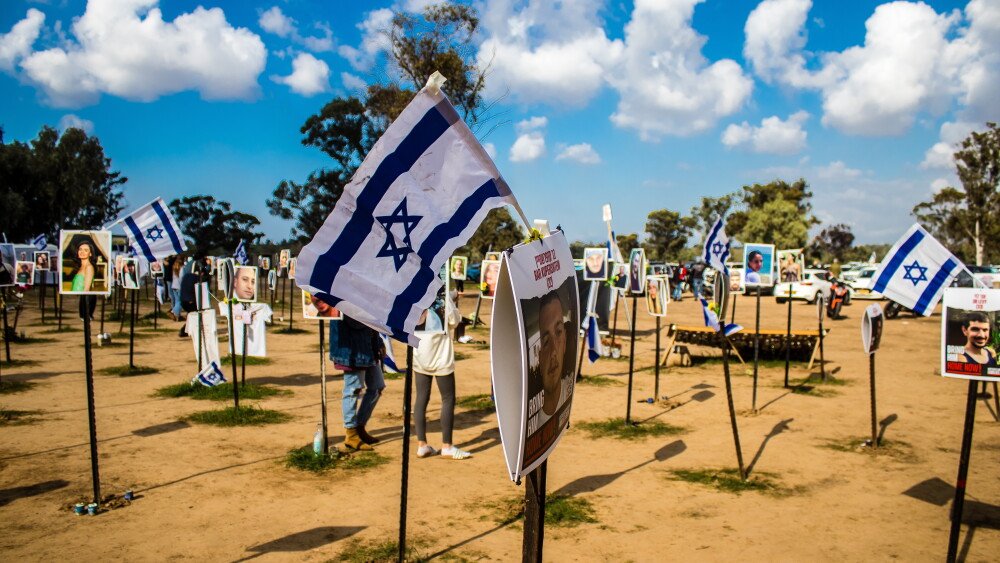
Three years after a national tragedy, you’d expect a country to have some distance, enough to look back, open up the archives, host academic conferences, add a few more plaques to the city, and treat the event as part of history. That’s what the calendar suggests, anyway. But for Israel, October 7, 2023 just refuses to fade into history. It’s not some chapter we can close; the wound it left is still raw and bleeding into everyday life. We’ve survived three years, but the aftermath still grips our borders, pressures our army, and stretches our society to the breaking point. Hamas isn’t just part of the past, it’s right there, active in Gaza. No one knows who’s going to control the Strip next. On top of that, there are threats from Iran and its proxies waiting on the other side of the border. For people living in Israel now, time hasn’t healed anything. It’s just forced us all to figure out how to keep going in the middle of a never ending crisis.
That whole saying, “time heals all wounds”, it falls apart when you listen to what people have actually been through. Take the hostages. Freedom isn’t just walking out and going home. For them, every day is a struggle to put some kind of life back together from what’s left. Emily Damari was dragged from her home in Kfar Aza and spent 471 days hidden away underground in Gaza. Now, when she describes life after captivity, it’s not about big moments. It’s about the small things, opening the fridge, drinking cold water. These simple acts are full of meaning and gratitude now. Her routines remind us: freedom isn’t this grand, abstract thing. It’s delicate, and it was won at a terrible price.
Then there’s Eli Sharabi, who was kidnapped from Kibbutz Be’eri and held for 491 days. He didn’t know that his wife, Lianne, and their daughters, Noiya and Yahel, were murdered in their home during the attack. His brother Yossi was also kidnapped, and died in Gaza. Now, coming back to a life that’s suddenly so empty, Eli didn’t just give in to despair. He made a conscious choice, not to surrender, but to choose life, carrying his family’s memory in everything he does. That kind of dignity gets right to the heart of what everyone here carries. People aren’t “moving on.” We’re all just hauling this heavy weight forward, step by step, because the only other option is to give up.
It’s not just about big national trauma either. The struggle sinks deep into home life. People have to find ways to keep living. Hagar Brodutch was taken with her three kids and a neighbor, and after they were released, the relief was overwhelming. But coming back is a slow, often invisible grind. She started baking pastries. Working dough with her hands isn’t just a distraction from what happened, it’s her way of seizing a little bit of control, slowly rebuilding something in the aftermath of chaos. Her story echoes everywhere: healing isn’t some dramatic redemption. It’s the quiet, stubborn act of rebuilding, piece by piece, right beside the grave of what was lost.
Still, you can’t expect raw courage and individual resilience to make up for institutional failure. The bravery shown by civilians and soldiers on October 7 speaks volumes, but it also exposes a glaring gap in leadership that’s still unresolved in the public arena. Look at Major Roee Negri, the 28 year old reserve officer. He spent precious hours saving lives at Be’eri before he was killed fighting. His mother, Michal Negri, now speaks for so many in Israel who are desperate for real answers from the state.
She asks a question that really can’t be avoided: how does a nation promise never to let this happen again if it refuses to look honestly at what went wrong and why?Her grief points to a bigger rupture, a breach of trust between people and government. You send your children into combat with the understanding that the state will do its part: lead with integrity, own up to mistakes, act responsibly. When that trust breaks, national unity itself starts to unravel. The families who lost loved ones aren’t out for revenge, they want the truth. Ignoring those questions just heaps on more pain, reinforcing the abandonment that started on October 7.
Even now, three years after 1,200 people were murdered and another 251 abducted, Israel still hasn’t set up an independent commission of inquiry to examine how military, political, and intelligence failures led to that day. That’s more than just a bureaucratic slip up.
It’s a serious abandonment of public responsibility. Setting up such a commission, with the power to force answers, is essential if people are ever going to trust the system protecting them. We need real investigation. Leaders and generals should answer pointed questions: How good was our intelligence? Were our borders properly defended? Why was our response so slow that morning? If there’s no honest reckoning, the state is effectively demanding citizens risk everything for a system that won’t admit when it fails.Without this commission, the tragedy of October 7 isn’t behind us. It stays stuck in political limbo, grinding away at public trust. Israel’s real strength doesn’t come from avoiding accountability or clinging to patriotic slogans. It comes from looking failure in the eye, demanding straight answers from leaders, and actually changing what needs to be changed in our defense forces. A country that refuses to confront its worst disasters ends up repeating them, there’s just no way around that.
There’s an international price, too. Our allies and the world at large are watching to see how Israel handles moments like this. A democracy that investigates its failures shows moral strength, the kind of authority that matters. If we don’t, we leave a void. Critics, and sometimes enemies, are more than happy to fill that gap with their own narratives. Setting up a truly independent state commission would send a clear signal that Israel holds to the rule of law, honest self examination, and real institutional integrity.
And now, with another major election ahead, regular people have a huge responsibility. The upcoming debates can’t just devolve into bitter internal fights or political games. Our enemies are the ones trying to destroy us from outside. Inside, we need to demand accountability, insist on proper leadership, and protect our democracy. October 7 is still part of our reality because the work of repairing what broke is nowhere near finished. The only way to honor the memory of those we’ve lost is not to accept what happened as just fate, but to keep pushing for a state that values its people as fiercely as they were defended.